Engaging business continuity planning consultants is no longer a 'nice-to-have' for...
Security Operations Centre: The Modern Australian SOC
First Published:
March 12, 2026
Content Written For:
Small & Medium Businesses
Large Organisations & Infrastructure
Government
Read Similar Articles
What is the NIST Cybersecurity Framework: A breakdown for Australian Organisations
So, what is the NIST Cybersecurity Framework? In simple terms, it is a voluntary set of guidelines...
CIO’s guide to Responding to an Incident in Australia
When your organisation is hit with a cyber security incident, your response must be fast,...
Your Guide to Building a Resilient Cyber Security Strategy
A modern cyber security strategy is not a document you write once and file away. It is a living...
A Strategic Guide to NIST CSF 2.0 for Australian Leaders
Released in early 2024, NIST CSF 2.0 represents the latest evolution of a globally recognised...
Think of a Security Operations Centre (SOC) as the nerve centre of your entire cybersecurity defence. Much like an air traffic control tower keeps a constant watch on the skies, a SOC provides around-the-clock monitoring of your digital environment. Consequently, its mission is to monitor, detect, analyse, and respond to cyber threats before they can disrupt your business.
This centralised function moves an organisation from a reactive, firefighting mode to a proactive security posture. In short, it actively safeguards your most critical data and systems.
Why a SOC is Essential for Modern Australian Businesses
In today's threat landscape, a Security Operations Centre is no longer a luxury for large corporations; it is a fundamental requirement for business resilience. It brings together the dedicated people, proven processes, and specialised technology needed to defend against sophisticated and relentless attacks.
Without this capability, organisations are often flying blind. Furthermore, they are slow to react to incidents and frequently struggle to understand the full scope of a breach, leaving them exposed to further damage.
For Australian business leaders, a SOC delivers tangible outcomes that go far beyond just blocking threats. Specifically, it directly underpins operational continuity, protects hard-earned brand reputation, and ensures the confidentiality of your customer and corporate data.
At its core, a SOC is the operational heart of your security strategy, responsible for several critical functions. The table below summarises these key responsibilities, therefore offering a quick overview for business leaders.
Core Functions of a Security Operations Centre
| Core Function | Description | Business Impact |
|---|---|---|
| Continuous Monitoring | Maintains 24/7 visibility across networks, endpoints, and cloud services using specialised tools to identify suspicious activity in real time. | Catches threats early, reducing the time an attacker has to cause damage. |
| Incident Response | Swiftly investigates, contains, and neutralises confirmed threats to minimise damage and business disruption. | Reduces downtime, limits financial loss, and enables a faster return to normal operations. |
| Threat Hunting | Proactively searches for hidden threats and vulnerabilities that may have evaded automated detection systems. | Uncovers advanced adversaries before they can launch an attack, preventing major incidents. |
These functions work together to create a powerful, coordinated defence. A SOC is far more than just a room with screens; it is a dynamic capability that allows your business to stay ahead of attackers.
A SOC centralises security expertise, enabling a coordinated and rapid response to cyber threats. This capability is critical for moving from a position of vulnerability to one of controlled, active defence, which is essential for risk management.
The Growing Need in Australia’s Threat Landscape
Investment in cybersecurity infrastructure is accelerating across Australia for a clear reason. The nation’s cybersecurity market is projected to grow from USD 3,252.5 million in 2025 to USD 9,137.2 million by 2033. This growth reflects the severe financial impact of cyber incidents.
This sharp increase in spending underscores a critical realisation among Australian boards and executives: a robust security posture, anchored by a Security Operations Centre, is a non-negotiable part of modern business strategy. As part of this, many organisations look to expert providers to deliver these outcomes, which is why understanding your options for MSSP security services is a crucial next step.
The Three Pillars of an Effective SOC

A world-class security operations center does not run on technology alone. It is a finely tuned system built on three core pillars: People, Process, and Technology. Think of it like a high-performance racing team—a brilliant driver (People) is useless without a race strategy (Process) or a competitive car (Technology).
If you get any one of these pillars wrong, the entire structure becomes unstable. For Australian business leaders, understanding how these three elements must work in harmony is the key to building or procuring a SOC that actually delivers on its promise of resilience. Let’s break down each pillar to see how they fit together.
People: The Expert Human Element
No matter how advanced the tools are, you cannot automate intuition or critical thinking. The real heart of any security operations center is its team of skilled, experienced analysts. These are the people who interpret complex alerts, hunt for hidden threats, and make crucial decisions when a real crisis hits.
A mature SOC organises its team into tiers, creating a clear escalation path. This ensures every alert gets the right level of attention quickly and efficiently.
-
Tier 1 Analysts: These are the first responders on the front line. Their job is to monitor the endless stream of alerts, separate the real signals from the noise, and escalate genuine incidents for deeper investigation.
-
Tier 2 Responders: When an incident is confirmed, it goes to these seasoned analysts. They dive deep to understand the scope and impact of an attack, then use documented playbooks to contain the threat and begin remediation.
-
Tier 3 Threat Hunters: This is the elite tier. These experts go beyond reacting to alerts and proactively hunt for adversaries that have slipped past automated defences. They use sophisticated techniques and deep intelligence to find threats that others would miss.
The threat landscape is always shifting, which means continuous training and skill development are not just a nice-to-have; they are essential for keeping the team effective.
Process: The Blueprint for Action
Without clear processes, even the most talented security team will eventually descend into chaos. Processes are the documented blueprints—the standard operating procedures (SOPs)—that ensure your team handles every security event consistently, efficiently, and without guesswork.
Well-defined processes turn security operations from a series of reactive, ad-hoc fire-fights into a disciplined and measurable function. That discipline is the foundation of effective risk management.
These documented workflows guide everything a SOC does, from how an initial alert is triaged to how a major incident is closed out. Following a methodical process is especially critical under the immense pressure of a live cyber-attack. It also creates an auditable trail of actions, which is vital for proving compliance with frameworks like ISO 27001 or the ACSC Essential Eight.
A key part of this is using intelligence to shape your defensive actions. Learning how to integrate cyber security threat intelligence is a critical step in maturing your SOC’s procedural framework.
Technology: The Integrated Tool Stack
Technology is the force multiplier that gives a small team of experts the power to defend an entire organisation. A modern SOC is not just a collection of tools; it is an integrated ecosystem where each component works together to provide visibility, automate repetitive work, and enable a rapid response.
The goal is not to buy every tool on the market. Instead, it is about creating an integrated stack that gives analysts a unified view—often called a ‘single pane of glass’—so they are not wasting precious time switching between dozens of different screens during an investigation.
Key technologies in a modern SOC toolset include:
-
SIEM (Security Information and Event Management): This is the central hub. A SIEM collects log and event data from across the entire network, correlates it to spot suspicious activity, and generates the alerts that kick off an investigation.
-
SOAR (Security Orchestration, Automation, and Response): This platform automates the repetitive, manual tasks that bog analysts down. For instance, a SOAR playbook can automatically block a malicious IP address or isolate an infected laptop, freeing up human experts to focus on the complex analysis.
-
XDR (Extended Detection and Response): An evolution of traditional endpoint tools, XDR integrates security data from endpoints, networks, cloud environments, and email systems. This provides a much richer context, helping analysts trace sophisticated attacks that move across different parts of the IT estate.
How a SOC Responds to Cyber Threats
When a threat hits your organisation, your security operations center does not just react with a single, panicked action. The response is a calm, well-drilled workflow designed to identify, contain, and learn from every incident.
Think of it as the digital equivalent of an emergency services response. Highly trained specialists follow a clear protocol, moving from initial alert to post-incident review to make sure nothing gets missed. Let’s walk through what that looks like in practice.
Detection
Everything starts with a signal. A modern SOC uses a range of tools, with a SIEM at the core, to watch over everything from laptops and servers to cloud environments. These systems are tuned to spot the faint signals that suggest an attack is unfolding.
An alert is the first indicator that something is not right. It could be triggered by an employee clicking a phishing link, unusual login activity, or strange data movements hinting at an intruder. That single alert kicks off the entire response.
Triage and Analysis
Once an alert fires, it lands with a Tier 1 analyst for triage. Their job is to quickly figure out if it is a real threat or just a false alarm. Many alerts are benign activities that just happen to look suspicious, so this step is critical for managing noise.
The analyst works to:
- Validate the Alert: Confirm if the activity is malicious or simply business-as-usual.
- Assess the Impact: Is this a single user’s laptop or a critical server with customer data? The context determines the severity.
- Prioritise the Threat: Assign a priority based on potential damage and urgency, ensuring the team focuses on what matters most.
This filtering process is vital. It stops the team from wasting time on low-risk events. If the threat is real, the analyst escalates it for a full investigation.
Investigation
Here, a more experienced Tier 2 analyst steps in. Their goal is to become a digital detective, piecing together the full story of the attack to understand exactly what happened, how it happened, and how far the attacker has penetrated the network.
They will dive deep into system logs and other data sources to answer the big questions:
- How did the attacker get in?
- Which systems or user accounts are compromised?
- What is their objective? Are they trying to steal data?
- Is data actively being exfiltrated?
This deep-dive investigation provides the clarity needed to build an effective response.
Response and Containment
With a clear picture of the attack, the SOC shifts to response and containment. The number one priority is to stop the bleeding. Therefore, it is all about isolating the threat to prevent it from spreading and causing more damage.
Containment is about surgically removing the threat while minimising disruption to the business. Quick, precise action at this stage can be the difference between a minor incident and a catastrophic breach.
Actions might include taking an infected laptop off the network, blocking a malicious IP address at the firewall, or immediately disabling compromised accounts. For a structured approach to this phase, see our guide on building a computer incident response plan.
Proactive Threat Hunting
While the steps above are all about reacting to alerts, a mature security operations center also hunts for threats proactively. This is where elite Tier 3 analysts come in.
Instead of waiting for an alarm, they actively search for adversaries who might have slipped past automated defences and are lying low in the network. It is the security equivalent of sending out patrols to find the enemy before they launch an attack.
Recovery and Post-Mortem
Once the team neutralises the threat, the focus turns to recovery. This involves carefully restoring any affected systems from clean backups and verifying that they are completely secure before bringing them back online.
Finally, the team conducts a post-mortem. This review dissects the entire incident to identify what went right, what went wrong, and—most importantly—what lessons can be used to harden defences against the next attack.
Choosing the Right SOC Model for Your Business
Deciding how to structure your security operations center is one of the most important strategic calls an Australian business leader can make. This choice ripples through everything—cost, control, and just how fast and effectively you can defend against a cyber attack.
There is no single “best” model. The right path depends entirely on your organisation’s risk appetite, budget, in-house talent, and long-term goals.
It all boils down to three main approaches: building your own SOC, outsourcing to a managed provider, or finding a middle ground with a co-managed model. Each offers a different trade-off between control, cost, and expertise. Making the right choice means taking a hard, honest look at what you can realistically do internally versus where you need specialist help from the outside.
This flowchart shows the decision-making process your security team follows when a threat pops up. It is the fundamental workflow at the heart of any SOC, no matter which model you choose.
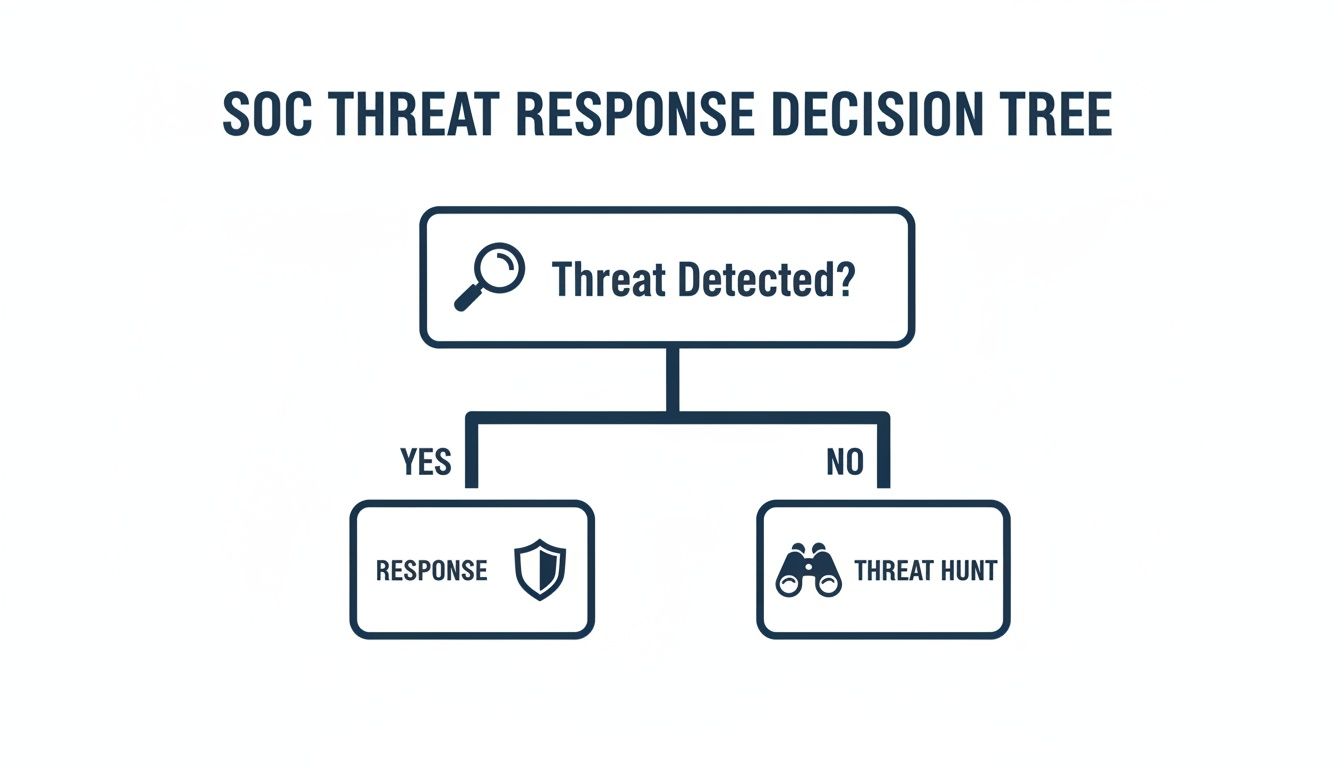
As you can see, a SOC’s work is a constant cycle of responding to known threats and proactively hunting for the ones that slip past traditional defences.
To help you weigh the options, we have put together a table comparing the three primary SOC operating models across the criteria that matter most to a business.
Comparison of SOC Operating Models
| Criteria | In-House SOC | Co-Managed (Hybrid) SOC | Managed SOC (MDR/MSSP) |
|---|---|---|---|
| Control | Maximum control over people, process, and technology. | Shared control; internal team leads, provider augments. | Minimal direct control; provider manages operations based on agreed outcomes. |
| Cost | Very high CAPEX and OPEX. Multi-million dollar setup and ongoing running costs. | Moderate OPEX, lower CAPEX. Balances internal salaries with provider fees. | Predictable OPEX. Fixed monthly or annual subscription fees. |
| Expertise | Dependent on internal hiring. Access to talent is limited by your ability to recruit and retain. | Blended expertise. Combines internal business knowledge with external specialist skills. | Immediate access to a large, mature team of security experts and threat hunters. |
| Coverage | Difficult to achieve 24/7. Requires at least 8-12 full-time staff to cover all shifts. | 24/7 coverage achieved. Provider handles after-hours, weekends, and holidays. | Full 24/7/365 coverage included as a standard feature. |
| Best For | Large enterprises, government, and highly regulated industries with specific needs. | Mid-market and enterprise organisations with an existing security team needing to scale. | SMEs and mid-market firms without the budget or resources for an in-house team. |
Each model has its place. The key is to match the model to your organisation’s unique circumstances and strategic objectives, not the other way around.
The In-House SOC
Building your own security operations center gives you the ultimate level of control. You get to hand-pick the team, choose every piece of technology, and fine-tune every process to fit your business operations and risk profile perfectly.
This model is a great fit for large enterprises or organisations in highly regulated sectors. These businesses need deep, specific knowledge of their own environment and customised security workflows.
However, that control comes at a steep price. The costs are not just for high-end technology and software licences. They also include the massive, ongoing expense of recruiting, training, and keeping a team of scarce and highly-paid cybersecurity experts. Consequently, running a true 24/7/365 in-house SOC is a multi-million-dollar commitment that is simply out of reach for most businesses.
The Managed SOC (MDR or MSSP)
For many Australian organisations, especially small to medium-sized enterprises (SMEs), outsourcing is the most practical and cost-effective route. A Managed SOC, often delivered as a Managed Detection and Response (MDR) service, gives you instant access to a mature, 24/7 operation staffed by a deep bench of experts.
This model brings several clear advantages:
- Predictable Costs: You pay a recurring subscription fee, turning a huge capital expense into a manageable operational one.
- Access to Expertise: You get the collective knowledge of a whole team of seasoned analysts, threat hunters, and incident responders.
- Advanced Technology: Providers bring their own enterprise-grade security stack, saving you from a massive technology investment.
- 24/7 Coverage: You are protected around the clock. This is critical, as attackers love to strike outside of your local business hours.
The main trade-off is giving up some direct control. While you set the high-level security goals, the provider handles the day-to-day operations using their own proven processes. For a more detailed comparison, you might be interested in our breakdown of SOC services vs MDR.
The Co-Managed (Hybrid) SOC
The co-managed or hybrid model offers a compelling middle ground, blending your internal team with the horsepower of an external provider. In this setup, your on-site team might handle daily security tasks during business hours. Meanwhile, the managed service provider takes over after-hours, on weekends, and for specialised jobs like threat hunting.
The co-managed SOC model empowers your internal team by augmenting them with specialist skills and 24/7 coverage, delivering the best of both worlds without the full cost of an in-house build.
This approach is becoming more popular because it lets your internal team keep control and business context while offloading the huge burden of 24/7 monitoring. It also gives you a vital escalation path for complex incidents that might be beyond your team’s current skill set. Of course, any effective response relies on having the right data breach prevention tools in place to support your team and processes.
This shift toward flexible, expert-driven security is reflected in market trends. The global Security Operations Center market is booming, projected to grow from USD 49.43 billion in 2026 to over USD 100.39 billion by 2035. Interestingly, the in-house SOC model is still expected to hold over 63.3% of the market by 2035. This shows a strong desire for customised control, especially in regions like Asia Pacific where cyber threats are becoming more complex. You can explore more on these trends in reports about the growing Security Operations Center market.
Measuring the Success of Your SOC
A security operations center is a significant investment. To justify that cost, it has to do more than just block threats—it needs to prove its value to the business in clear, measurable terms.
Tracking SOC performance is not about pointing fingers when something goes wrong. Instead, it is about using hard data to spot bottlenecks, argue for resources, and drive continuous improvement in your security posture. For Australian CISOs and IT managers, the right metrics shift the conversation from technical jargon to tangible business outcomes, making the case for ROI.
These metrics generally fall into two camps: operational metrics that show how well the team is working, and business-aligned metrics that measure the impact of that work.
Key Operational Metrics
Operational metrics give you a direct view of the SOC’s speed and efficiency. These are the nuts and bolts of day-to-day threat management, telling you how quickly your team can handle incidents. They offer an immediate pulse check on performance and help you see where processes are breaking down or where automation could make a real difference.
Key operational KPIs to keep an eye on include:
- Mean Time to Detect (MTTD): This is the average time it takes your team to spot a security incident from the moment it kicks off. A lower MTTD is always the goal—it means you give attackers less time to move around your network unnoticed.
- Mean Time to Respond (MTTR): This tracks the average time from the first alert to when your team fully contains and fixes an incident. A low MTTR shows your team can act decisively to minimise the damage.
- Alert Volume and Fidelity: This is not just about counting alerts. It is about tracking how many alerts turn out to be real threats (true positives) versus how many are just noise (false positives). A high noise ratio burns out analysts and creates the risk that a genuine threat gets missed.
Effective measurement is about understanding your team’s capacity and optimising its focus. Tracking these core operational metrics helps ensure your analysts are spending their valuable time on genuine threats, not chasing ghosts in the system.
Business-Aligned Metrics
While operational metrics are crucial for the team, business-aligned metrics are what get the board’s attention. These KPIs translate the SOC’s technical work into the language of finance and risk—the language executives understand. They answer the critical question: “How is the security operations center protecting the business and saving us money?”
These are the metrics you need to build a solid case for future budgets and prove your security program’s value. You can find out more by exploring the ROI of managed detection and response in detailed industry reports.
Important business-aligned metrics include:
- Dwell Time Reduction: This is the total time an attacker remains active inside your network before you kick them out. Globally, dwell time still averages several weeks. Reducing it is a powerful sign of a mature SOC that can effectively limit potential damage.
- Cost Per Incident: By calculating the total cost of your SOC—people, tools, and services—and dividing it by the number of incidents handled, you can track efficiency over time. As the SOC matures and refines its processes, this cost should ideally trend downwards.
- Incident Impact Reduction: This involves measuring the business impact of incidents, such as the number of systems compromised, the amount of data lost, or the cost of downtime. A clear downward trend proves the SOC is successfully reducing the severity of security events.
Aligning Your SOC with Australian Compliance
For Australian organisations, compliance is far more than a box-ticking exercise—it is fundamental to managing risk and maintaining customer trust. A modern security operations center is not just a technical function; it is the engine that drives continuous compliance.
A SOC transforms regulatory adherence from a stressful, periodic audit into a constant, verifiable process. Instead of scrambling for proof when an auditor arrives, your team has a living record of your security posture, making compliance a natural outcome of good security hygiene.

Meeting the ACSC Essential Eight Mandate
The Australian Cyber Security Centre’s (ACSC) Essential Eight is the baseline for protecting organisations from most cyber threats. Many of its controls are not set-and-forget; they demand the exact kind of ongoing vigilance a SOC is built to deliver.
A SOC’s core functions directly support key Essential Eight maturity levels. Controls around event logging, analysis, and response are not just part of what a SOC does—they are what a SOC does, every single day. This is how organisations achieve and maintain higher maturity levels within the framework.
- Continuous Monitoring: A SOC’s 24/7 monitoring directly addresses the need to detect and investigate cyber events across all your endpoints, servers, and applications.
- Incident Response: When an alert fires, the SOC’s documented playbooks ensure a fast, consistent response, which is a key requirement of the Essential Eight.
Supporting ISO 27001, SOC 2, and IRAP
Beyond the Essential Eight, a security operations center is also fundamental to achieving and maintaining other critical certifications. Frameworks like ISO 27001, SOC 2, and IRAP all demand auditable proof that your security controls are in place and working effectively.
A SOC provides this proof through its technology and operational records. The extensive logs, centralised alert management, and detailed incident reports generated by a SOC become the definitive evidence an auditor needs to verify your compliance.
For frameworks like ISO 27001 and SOC 2, the auditor’s question is always, “Show me.” A SOC gives you the data-backed answer, demonstrating that security policies are not just written down but are actively enforced and monitored around the clock.
This capability is especially vital for organisations aiming to work with government agencies, where an Information Security Registered Assessors Program (IRAP) assessment is often mandatory. IRAP assessments rigorously examine your security controls, and a SOC’s ability to produce detailed logs and demonstrate a robust incident response process is critical for a successful outcome.
Transforming Compliance into a Business Enabler
Ultimately, a security operations center changes the entire conversation around compliance. It moves your organisation away from a reactive, audit-driven cycle and towards a state of continuous, proactive assurance.
This shift not only reduces organisational risk and makes certification easier but also builds a stronger, more resilient business. This continuous validation means you are always ready for an audit. More importantly, you have a much clearer and more accurate picture of your actual security posture, enabling smarter, risk-informed business decisions.
Frequently Asked Questions
This section tackles the common questions we hear from Australian business and IT leaders when they’re thinking about a security operations center. The answers are designed to give you clear, analyst-grade advice to help you make the right call for your organisation’s security.
How Much Does a SOC Cost?
The cost really does vary depending on which model you go with. Building your own in-house SOC is a multi-million dollar undertaking, factoring in steep salaries for a 24/7 team and expensive technology licences.
A managed SOC (often called MDR) is a much more cost-effective route. It turns that massive capital investment into a predictable monthly operational expense. For small businesses, this can start from just a few thousand dollars a month and scales up from there.
Do We Need a 24/7 SOC?
For the vast majority of organisations, the answer is a firm yes. Cyberattacks do not stick to Australian business hours. In fact, attackers love to strike on weekends or public holidays when they know your team is stretched thin or offline completely.
Without 24/7 monitoring, a threat that lands on a Friday evening could go completely unnoticed until Monday morning. That gives an adversary more than 48 hours to move through your network and cause enormous damage. A round-the-clock operation means your team spots and deals with threats immediately, no matter when they occur.
Relying on a 9-to-5 security team is like locking your front door but leaving the back door wide open overnight. A 24/7 SOC is essential for continuous protection against modern, persistent threats.
Can We Build Our Own SOC Instead of Outsourcing?
Technically, yes, but it is an incredibly difficult path for most organisations to take. The biggest hurdles are the fierce competition for a very small pool of cybersecurity talent and the sky-high costs involved. Building and, more importantly, retaining a skilled team of 8-12 analysts to provide genuine 24/7 coverage is often unsustainable.
There’s another critical issue specific to Australia’s incident response market. Experts have been warning that Australia faces a severe shortage of experienced incident responders, with just a handful of firms handling almost all major breaches. As you can discover in more detail, this creates a huge concentration risk. During a widespread cyber incident, there simply would not be enough experts to go around.
This reality makes partnering with a dedicated managed SOC provider a strategic imperative. It is about securing those expert resources before a crisis hits.
What Is the First Step to Getting a SOC?
The first practical step is always a thorough risk assessment. You need to get a clear picture of your specific security needs, any compliance obligations you have, and what your budget can realistically support.
This assessment will clarify which of your assets are most critical to protect and what level of security coverage they require. This information is the foundation for deciding whether an in-house, co-managed, or fully managed security operations center is the right fit for your business.
Ready to move from reactive defence to proactive resilience? CyberPulse provides expert-led managed SOC services and compliance support to help Australian organisations stay ahead of threats and audit-ready. Strengthen your security posture by visiting us at https://www.cyberpulse.com.au.
Browse to Read Our Most Recent Articles & Blogs
Subscribe for Early Access to Our Latest Articles & Resources
Connect with us on Social Media