Managed siem services are on the shortlist for many Australian security leaders for one simple...
A Guide to Cybersecurity Threat Intelligence
First Published:
February 21, 2026
Content Written For:
Small & Medium Businesses
Large Organisations & Infrastructure
Government
Read Similar Articles
Pen Testing as a Service: What It Is and How It Works
Traditional penetration testing has a fundamental timing problem. A point-in-time engagement gives...
Cloud Computing Security Services for Australian Businesses
As Australian businesses accelerate their move into the cloud, securing those digital environments...
SMB1001: A Cybersecurity Framework Guide for Australian Businesses
This article provides a guide to the SMB1001 framework. Cyber attacks now hit Australian...
How to defend against Infostealer Malware
Infostealer malware is not just another cyber threat. It is a silent data thief designed to...
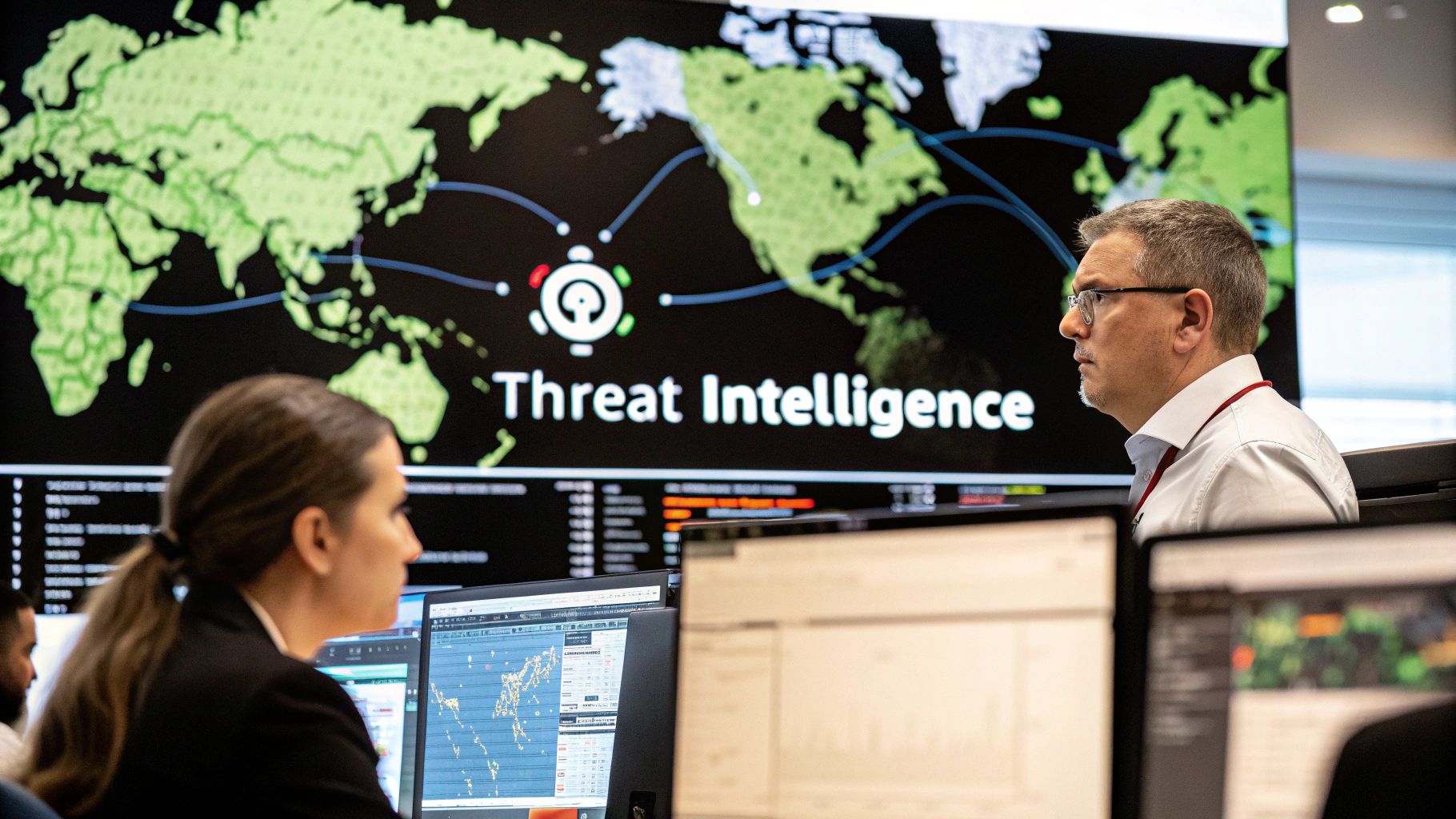
Security leaders often describe their operations as a reactive cycle of "whack-a-mole"—an unsustainable loop of detecting and responding to endless alerts. This constant firefighting is not only inefficient but also strategically flawed, leaving organisations exposed. Operating without a formal intelligence function is akin to navigating a complex threat landscape blindfolded, where strategy is based on hope rather than evidence-based foresight.
This is where Cybersecurity Threat Intelligence (CTI) provides a foundational shift. CTI is not merely data about potential attacks; it is evidence-based knowledge that delivers a deep, contextual understanding of the adversaries, their motivations, and their methods.
Shifting From Reactive Defence to Proactive Posture with Threat Intelligence

Effective CTI transforms a deluge of raw, unstructured data into a strategic asset. It provides the situational awareness required to move from a defensive posture to an intelligence-led one. Instead of simply reacting to incidents as they occur, a CTI-driven security program anticipates an adversary's next move. This represents the difference between constructing a generic perimeter defence and strategically reinforcing the specific attack vectors identified as most probable.
Proactive Defence Through Predictive Insight
An intelligence-led, proactive stance is built on core principles that distinguish CTI from simple data feeds:
-
Evidence-Based Knowledge: CTI is derived from the rigorous analysis of empirical data from past and current attack campaigns, not speculation.
-
Contextualisation: True intelligence provides critical context regarding threat actors, their motivations, and their specific tactics, techniques, and procedures (TTPs).
-
Actionable Application: The primary objective of CTI is to generate insights that directly inform defensive controls, vulnerability management priorities, and incident response plans.
CTI empowers security leaders to make risk-based decisions grounded in data. It moves the conversation from "Are we secure?" to "Are we secure against the threats that matter most to us, right now?"
By integrating CTI into security operations, an organisation ceases to be a passive target. It becomes an active participant in its own defence, predicting and countering threats before they result in material impact. This intelligence-led methodology is fundamental for building a resilient security posture capable of withstanding the sophisticated attacks detailed in publications like the ASD Cyber Threat Report.
Ultimately, CTI provides the foresight needed to protect critical assets. It allows security teams to focus their finite resources—time, budget, and personnel—on the threats that pose the greatest risk to the organisation, thereby optimising the efficacy of the entire security program.
Understanding The Four Levels of Threat Intelligence
Effective cyber threat intelligence is not a monolithic entity. It is a layered framework, with each layer designed to inform different stakeholders within an organisation, from executive leadership to analysts in the Security Operations Centre (SOC).
Categorising intelligence in this manner is crucial for ensuring the right information reaches the right audience in a usable format. A Chief Information Security Officer (CISO) requires high-level strategic analysis, not a raw feed of malicious IP addresses. Conversely, a SOC analyst needs timely, tactical indicators, not a broad assessment of geopolitical cyber risk. Each role requires a distinct level of intelligence to function effectively.
Let's examine these four layers.
Strategic Threat Intelligence
At the apex is Strategic Threat Intelligence. This provides a high-level, "30,000-foot" view tailored for executive leadership, board members, and CISOs. It addresses broad questions, such as, "Which threat actors are likely to target our industry and why?" and "What are the primary cyber risks to our business over the next 12-24 months?"
Strategic intelligence focuses less on technical minutiae and more on the global threat landscape, including the motivations, intent, and capabilities of major threat actor groups. For example, a strategic report might analyze how a state-sponsored group is escalating its focus on the Australian financial sector, providing the board of a major bank with the justification needed to increase investment in specific defensive technologies.
This level of insight drives long-term risk management strategies, shapes security budgets, and ensures the security program is aligned with overarching business objectives.
Operational Threat Intelligence
The next layer is Operational Threat Intelligence, which details the "who, what, and how" behind specific attack campaigns. Its primary audience includes security managers, incident responders, and threat hunters—personnel who must understand an adversary's mindset and methodology.
Operational intelligence provides rich, contextual detail on an adversary’s Tactics, Techniques, and Procedures (TTPs). It is, in effect, the adversary’s playbook. This intelligence illuminates their campaign infrastructure, preferred tools, and common attack patterns. For example, it might reveal that a specific ransomware group consistently gains initial access via phishing emails with macro-enabled documents and subsequently uses a particular tool for lateral movement.
This knowledge empowers defenders to shift from reacting to isolated alerts to anticipating an attacker's next move. It enables them to build more resilient defences, develop targeted detection rules, and hunt for threats based on known adversary behaviours.
By understanding how a threat actor operates, security teams can shift their focus from blocking a single malicious file to disrupting the entire attack chain. This operational context is what turns raw data into a true defensive advantage.
The following graphic from Gartner provides a solid definition of threat intelligence, which really gets to the heart of what these different levels aim to achieve.
This definition's focus on "evidence-based knowledge" that is "contextualised" and "actionable" is precisely what makes operational and tactical intelligence so valuable on the front lines.
Tactical Threat Intelligence
Next is Tactical Threat Intelligence, which is focused on the immediate term. This intelligence is designed for defenders on the front lines: SOC analysts and IT administrators. It provides concrete details about attacker TTPs to help teams identify and neutralize malicious activity as it occurs.
Tactical intelligence might include updates on malware delivery systems used in current campaigns or the command-and-control servers an attacker is known to favour. This allows security teams to fine-tune their security information and event management (SIEM) rules and endpoint detection and response (EDR) policies to detect these activities in real-time.
For instance, a tactical report might warn that a threat actor is actively exploiting a new vulnerability. Security teams can immediately use this information to prioritize patching that specific flaw or create a custom detection rule to identify any attempted exploitation.
Technical Threat Intelligence
The foundational layer is Technical Threat Intelligence. This is the most granular and ephemeral form of intelligence, focused on specific Indicators of Compromise (IOCs). IOCs are the digital artifacts an attacker leaves behind.
Technical intelligence consists of discrete data points such as:
-
Malicious IP addresses
-
Known phishing email domains
-
Malware file hashes
-
Command-and-control (C2) server URLs
While this data has a very short shelf life—as attackers constantly rotate infrastructure—it is ideal for immediate, automated blocking. These IOCs are ingested directly by security tools like firewalls, web proxies, and endpoint protection platforms to block known threats at machine speed, forming the foundational layer of any intelligence-led defence.
The following table provides a summary of how these four levels of CTI are utilized within an organisation.
The Four Levels of Cyber Threat Intelligence at a Glance
| Intelligence Type | Primary Audience | Focus & Use Case | Example |
|---|---|---|---|
| Strategic | Executives, Board, CISO | High-level view of the threat landscape. Used for long-term planning, risk management, and budget allocation. | A report on nation-state actors targeting the Australian energy sector over the next 18 months. |
| Operational | Security Managers, IR Teams | Details on attacker TTPs (Tactics, Techniques, Procedures). Used to understand how adversaries operate. | An analysis of a ransomware group’s attack chain, from initial access to data exfiltration. |
| Tactical | SOC Analysts, IT Admins | Specific attacker methodologies and tools. Used for creating and refining detection rules in SIEMs and EDRs. | A bulletin on a new phishing campaign using a specific type of malicious document. |
| Technical | Security Tools (Firewalls, EDR) | Indicators of Compromise (IOCs). Used for immediate, automated blocking of known threats. | A feed of malicious IP addresses, domain names, and file hashes. |
Each of these intelligence types performs a distinct and vital function. Without the high-level direction of strategic intelligence, security efforts risk misalignment with business objectives. Without the granular, real-time data from technical intelligence, defences can be easily circumvented. A mature security program must effectively source, process, and apply all four.
The Threat Intelligence Lifecycle: A Continuous Process
High-value threat intelligence is not a product acquired off the shelf. It is the refined output of a continuous, cyclical process that transforms raw, disparate data into clear, actionable security insights.
This structured methodology is known as the Threat Intelligence Lifecycle. Modelled on frameworks used by national intelligence agencies, it provides a disciplined approach to producing intelligence that is relevant, accurate, and timely. It functions as a constant feedback loop rather than a linear process with a defined start and end.
Each stage builds upon the previous one, ensuring the final intelligence product directly addresses the organisation’s most critical security questions.
Stage 1: Planning and Direction
The cycle begins with a critical question: “What information do we need to know to better protect the organisation?” This initial phase, Planning and Direction, focuses on defining intelligence requirements. These requirements must be specific and tightly aligned with the organisation’s critical assets, primary risks, and strategic goals.
For example, a fintech company will require intelligence on threat actors targeting online payment platforms, whereas a hospital’s priority will be groups known for deploying ransomware against healthcare providers. Without this clear direction, the subsequent stages risk becoming an exercise in collecting irrelevant noise.
Stage 2: Data Collection
Once requirements are defined, the Collection phase begins. This involves gathering raw information from a wide array of sources.
Common sources include:
-
Internal Data: Information from proprietary security tools, including network logs, SIEM alerts, and endpoint detection records.
-
Human Intelligence (HUMINT): Insights gathered from trusted contacts within security communities or industry forums.
-
Open-Source Intelligence (OSINT): Publicly available data from news reports, security blogs, social media, and academic research.
-
Technical Feeds: Data from dark web forums, malware sandboxes, and commercial threat intelligence providers.
The volume of available data is significant. The Australian Signals Directorate (ASD), for instance, handled over 42,500 calls to its cybersecurity hotline in a single year—approximately 116 calls per day. Coupled with over 1,200 cybersecurity incidents and 84,700 cybercrime reports, these figures from the government’s annual cyber threat report illustrate the immense scale of raw data that security teams must navigate.
Stage 3: Processing and Analysis
Raw data is inherently unstructured and often unusable in its original form. The Processing stage involves cleaning, structuring, and enriching this information into a format suitable for analysis. This may include translating data, standardising log formats, or adding contextual metadata.
Following processing, the Analysis phase commences. Here, human expertise and analytical tools converge to transform organised data into intelligence. Analysts identify patterns, correlate seemingly unrelated events, and assess the credibility of sources to answer the requirements defined in the planning stage.
This is the crucial, human-led step where data becomes knowledge. An analyst might connect a suspicious IP address to a known command-and-control server, link that server to a specific threat actor’s TTPs, and conclude that your organisation is at immediate risk.
Stage 4: Dissemination and Feedback
Finally, the finished intelligence must be delivered to stakeholders who can act upon it. The Dissemination stage involves packaging these insights into a clear, understandable format tailored to the specific audience, whether it is a technical alert for the SOC team or a high-level briefing for the board.
The lifecycle concludes with Feedback, arguably its most critical component. Intelligence consumers report back on its usefulness, accuracy, and timeliness. This feedback is then channelled directly into the next cycle of Planning and Direction, refining requirements and making the entire process more effective over time. This continuous loop establishes threat intelligence as a powerful, ever-improving defensive capability.
How CTI Enhances Security Operations

This is where the theoretical value of threat intelligence translates into tangible operational impact. Actionable CTI functions as a force multiplier, enhancing the efficacy and efficiency of every component of a security program. It is not a siloed function but an integrated capability that transforms a security stack from a collection of disparate tools into a coordinated, intelligence-led defence system.
In the current threat landscape, this is non-negotiable. Australia has experienced 47 million data breaches in a single year, positioning the nation as the fourth most targeted globally for cyber attacks. A concerning 11% of these attacks have impacted critical infrastructure.
Simultaneously, phishing attacks have surged. An average of 1.2% of Australian employees click on malicious links each month—a 140% year-over-year increase, largely driven by sophisticated, AI-powered campaigns. Understanding these trends is the first step; implementing a proactive defence is the only logical response.
Supercharging Detection and Response
One of the most immediate benefits of CTI is its ability to augment Managed Detection and Response (MDR) services. An MDR team without threat intelligence operates with a significant disadvantage—akin to a detective arriving at a crime scene with no prior knowledge of potential suspects. They can observe events but lack the context to understand their significance or predict what may happen next.
CTI provides this crucial context. When an alert is triggered, threat intelligence can instantly enrich it with details about the associated threat actor, their known TTPs, and whether the activity is part of a broader campaign. This allows security analysts to validate threats faster and with greater confidence. Our guide on Managed Detection and Response services in Australia explores this synergy in greater detail.
With CTI, an alert is no longer just a suspicious IP address. It becomes a known indicator linked to a specific ransomware group that prefers a certain method of lateral movement, allowing the MDR team to immediately begin hunting for that exact behaviour.
Equipping Incident Response Teams
During a live security incident, speed and foresight are paramount. Incident Response (IR) teams equipped with CTI possess a significant advantage because they are not starting from a position of ignorance. They effectively have a copy of the attacker’s playbook.
High-quality CTI provides IR teams with insight into emerging threats and attack patterns, including vulnerabilities in advanced systems like those found when analyzing Artificial Intelligence security failures. This knowledge allows them to anticipate an adversary’s next move. For instance, if intelligence indicates a particular threat group consistently attempts to delete system logs after gaining access, the IR team can prioritize securing those logs.
This proactive approach facilitates faster breach containment, reduces overall impact, and disrupts the attacker’s kill chain.
Revolutionising Vulnerability Management
Vulnerability management can often feel like an unwinnable exercise. Security teams are inundated with a constant stream of patches, often with little guidance on where to focus their efforts first.
CTI provides the necessary prioritization framework. It helps answer the critical question: Which vulnerabilities are adversaries actively exploiting in the wild right now?
Instead of relying solely on generic CVSS scores, threat intelligence highlights the specific flaws being weaponized in current attack campaigns. This intelligence-led approach enables teams to:
-
Prioritise with confidence: Remediate the 10 vulnerabilities being used by active threat groups before addressing the 1,000 others that represent only theoretical risks.
-
Allocate resources efficiently: Focus patching efforts on the systems and applications most likely to be targeted, maximizing risk reduction.
-
Strengthen defensive posture: By closing the exact entry points adversaries are seeking, the organisation becomes a much harder and less attractive target.
This shift from a compliance-driven patching schedule to a threat-informed one is fundamental. It ensures that limited resources are consistently directed at mitigating the most immediate and relevant risks, making the entire security investment smarter and more impactful.
Building Your CTI Capability
Advancing from consuming threat intelligence to developing an in-house capability is a significant strategic step. It requires more than just acquiring a new tool; it involves establishing a comprehensive system of data, technology, and human expertise to gain a genuine advantage over adversaries.
This journey begins with data sources. High-fidelity intelligence is refined from diverse information streams, each playing a specific role. Achieving the right mix of sources is key to developing a holistic view of the threat landscape.
Choosing Your Intelligence Sources
A robust CTI program will draw from three primary categories of data. The skill lies in balancing them to produce insights that are both broad enough to identify trends and specific enough to protect the organisation.
-
Open-Source Intelligence (OSINT): This encompasses all publicly available information—security blogs, news sites, government alerts (such as those from the Australian Cyber Security Centre (ACSC)), and academic papers. It offers a cost-effective method for gaining general threat awareness.
-
Commercial Intelligence: These are curated threat feeds and detailed reports from specialist security vendors. They provide high-quality, pre-vetted, and contextualized data, saving internal teams significant time and effort.
-
Proprietary Intelligence: This is the data generated internally by an organisation’s own security tools. Logs from firewalls, SIEM, and endpoint detection platforms are an invaluable source of intelligence on threats targeting the organisation directly.
A mature CTI capability masterfully combines these sources. OSINT provides the wide-angle view, commercial feeds offer expert context on active campaigns, and proprietary data gives you the ground-truth about what’s happening on your own turf.
Selecting the Right Tools and Partners
With a data strategy in place, the next component is the technology to centralize and analyze this information. A Threat Intelligence Platform (TIP) serves as the central hub for a CTI program, aggregating data from multiple sources and enabling analysts to identify meaningful connections.
When evaluating a TIP or a managed intelligence vendor, consider these critical questions:
-
Data Quality and Relevance: Does the provider offer intelligence specific to your industry and geography? A high volume of irrelevant data is counterproductive.
-
Integration Capabilities: How seamlessly does the platform integrate with your existing security stack? It must be able to feed actionable data to your SIEM, SOAR, and firewalls to automate defensive actions.
-
Actionable Insights vs. Raw Data: The objective is not to inundate your team with indicators. A valuable partner delivers finished intelligence with context—the who, what, and why—that facilitates rapid, confident decision-making.
These investments are especially critical in Australia. A recent analysis in the latest threat report revealed that Business Email Compromise (BEC) remains the top incident type, with an alarming 75% of attacks bypassing multi-factor authentication. Espionage threats are even more concerning; the average dwell time for these incidents has expanded to 404 days, providing nation-state actors over a year of undetected network access.
Ultimately, building a CTI capability requires strategic choices aligned with your organisation’s security maturity, budget, and risk appetite. It is an investment that enhances the efficacy and proactivity of the entire security program.
Actionable Next Steps for Australian Businesses
Understanding threat intelligence is the first step; operationalizing it is where tangible value is realized. The objective is to translate these concepts into a concrete action plan that measurably improves defensive posture. For Australian organisations of all sizes, there is a clear path forward.
The key is to start with existing resources and build momentum. A significant budget or a dedicated team of analysts is not a prerequisite for benefiting from an intelligence-led security approach.
For Small and Medium-Sized Enterprises
For smaller businesses, the focus should be on high-impact, low-cost initiatives that deliver immediate value. The goal is to mitigate common threats using existing resources without substantial upfront investment.
A practical starting point includes:
-
Subscribe to ACSC Alerts: The Australian Cyber Security Centre (ACSC) provides high-quality, no-cost intelligence directly relevant to Australian businesses. Subscribing to their partner program and alerts provides timely information on active campaigns targeting local organisations.
-
Enable Threat Feeds in Existing Tools: Many modern security platforms—such as firewalls and endpoint protection—have built-in capabilities to ingest threat intelligence feeds. Review your existing technology stack and activate these features to begin automatically blocking known malicious IPs and domains.
-
Focus on Tactical Intelligence: Prioritise intelligence that helps defend against prevalent threats like business email compromise and ransomware. This information can guide security awareness training and enhance the configuration of email security filters.
For Large Enterprises
Larger organisations with greater resources and more complex risk profiles require a more structured and strategic approach. The objective is to establish a formal CTI program that aligns directly with business objectives and provides a measurable return on investment.
A strategic roadmap for an enterprise should include:
-
Defining Intelligence Requirements: Begin by identifying critical assets and the specific threats that pose the greatest risk. These become your Priority Intelligence Requirements (PIRs) and will guide the entire program, ensuring all collection efforts are relevant.
-
Establishing a Formal CTI Program: Develop a clear charter for the CTI function, outlining its mission, stakeholders, and processes. This formalizes CTI as a core capability within security operations rather than an ad-hoc activity.
-
Evaluating Managed Services and Platforms: To accelerate capabilities, evaluate specialized partners. Consider engaging a Managed Security Service Provider (MSSP) with a strong CTI offering or investing in a Threat Intelligence Platform (TIP) to aggregate and analyze data from multiple sources.
The ultimate goal for any organisation, regardless of size, is to move from simply knowing about threats to actively using that knowledge to build a more resilient security posture. Every step taken, big or small, contributes to a smarter, more proactive defence.
Frequently Asked Questions
Adopting cyber threat intelligence often raises several common questions about its practical application. Here are concise answers to some of the most frequent queries.
How Is Cyber Threat Intelligence Different From a News Feed?
The distinction is fundamental. A news feed reports on what has already occurred—for example, a major data breach becomes a headline. This is reactive, providing a summary after the event.
Cyber security threat intelligence, by contrast, is designed to provide a predictive advantage. It is processed, analyzed, and contextualized information that details how an attack was executed, what tools were used, and—most importantly—whether your own organisation is vulnerable to the same tactics.
CTI is tailored and actionable, designed to help you build a proactive defence. A news feed offers general awareness but no clear path forward. Real intelligence lets you get ahead of threats before they hit.
Can a Small Business Benefit from Threat Intelligence?
Absolutely. A large, dedicated intelligence team is not a prerequisite for benefiting from a CTI mindset. For smaller businesses, the key is to leverage accessible, high-impact resources.
An excellent starting point for SMEs is consuming open-source intelligence (OSINT) from trusted sources like the Australian Cyber Security Centre (ACSC). This provides relevant, localized threat information at no cost. Additionally, many modern security tools, from endpoint protection to email security gateways, include built-in threat intelligence feeds that can be activated for immediate protection.
For businesses seeking to enhance their security posture, partnering with a managed security service provider (MSSP) offers access to enterprise-grade threat intelligence and expert analysis without the significant overhead, effectively levelling the playing field against common adversaries.
How Do You Measure the ROI of a CTI Program?
Measuring the return on investment for CTI requires tracking concrete improvements in security operations and efficiency, not relying on a vague sense of being “more secure.” Intelligence activities must be linked to tangible metrics.
Key performance indicators (KPIs) to monitor include:
-
Faster Response: A significant reduction in mean time to detect (MTTD) and mean time to respond (MTTR) for security incidents.
-
Fewer Successful Attacks: A measurable decrease in high-severity incidents and successful breaches over time.
-
Smarter Patching: Improved prioritization in vulnerability management, demonstrated by patching actively exploited vulnerabilities first.
-
Increased Automation: A higher percentage of threats being blocked automatically by security tools tuned with current threat intelligence.
Over time, a well-implemented CTI program will demonstrate a clear, quantifiable reduction in both the organisation’s risk profile and the operational costs associated with managing security incidents.
At CyberPulse, we help Australian businesses build resilient, intelligence-led security programs. We translate complex threat data into actionable strategies that strengthen your defences and ensure continuous compliance. Move from reactive to proactive security with our expert guidance.
Browse to Read Our Most Recent Articles & Blogs
Subscribe for Early Access to Our Latest Articles & Resources
Connect with us on Social Media