This article provides a guide to the SMB1001 framework. Cyber attacks now hit Australian...
What is Governance Risk and Compliance? A Guide for Australian Leaders

First Published:
March 30, 2026
Content Written For:
Small & Medium Businesses
Large Organisations & Infrastructure
Government
Read Similar Articles
How to defend against Infostealer Malware
Infostealer malware is not just another cyber threat. It is a silent data thief designed to...
A Guide to NIST Cybersecurity Framework Implementation
Getting a NIST Cybersecurity Framework implementation right is a strategic project, not just a...
What Is an Intrusion Test? A Guide for Australian Businesses
An intrusion test is an authorised, simulated attack on your organisation's systems, networks, or...
What is Endpoint Detection and Response?
Think of Endpoint Detection and Response (EDR) as an elite security detail for every single device...
So, what exactly is governance, risk, and compliance (GRC)? You've likely heard the term, but it is often treated as just another piece of corporate jargon. In reality, GRC is the integrated system that aligns an organisation’s IT and security operations with its wider business goals, all while managing risks and meeting its legal duties.
It’s not a cost centre. It is the command centre.
GRC: A Strategic Framework for Modern Business
Instead of treating governance, risk management, and compliance as separate silos, GRC brings them together into a single, cohesive strategy. This unified approach is what allows leaders to make smart, informed decisions, use resources effectively, and build a truly resilient organisation.
A helpful way to think about it is to imagine your organisation as a ship on a commercial voyage:
- Governance is the leadership team setting the ship’s destination and defining the rules for the journey. It answers the big-picture questions: ‘Where are we going and how will we conduct ourselves to get there?’
- Risk Management is the crew scanning the horizon for storms, icebergs, or pirates. It’s constantly asking: ‘What could go wrong, and what’s our plan to handle it?’
- Compliance is the officer with the rulebook, making sure the ship adheres to all maritime laws and port regulations. It deals with the practicalities: ‘How do we prove to authorities that we’re operating by the book?’
When these three work in harmony, the ship doesn’t just arrive safely—it gets there efficiently and profitably.
To break it down even further, here’s a quick look at how each pillar functions and the core question it answers for the business.
The Three Pillars of GRC at a Glance
| Pillar | Core Function | Key Question It Answers |
|---|---|---|
| Governance | Sets the organisation’s direction, objectives, and ethical boundaries. | Where are we going and what are the rules? |
| Risk Management | Identifies, assesses, and responds to threats that could derail objectives. | What could go wrong and how do we prepare? |
| Compliance | Ensures the organisation meets its legal, regulatory, and contractual duties. | How do we follow the rules and prove it? |
Seeing these pillars side-by-side makes it clear why they need to be integrated. A decision made in one area directly impacts the others.
Why This Matters for Australian Leaders
For Australian organisations, this integrated approach is no longer optional. It is a business necessity. According to PwC's Global Compliance Survey, a massive 56% of Australian executives reported that compliance problems held back key growth initiatives. The function hit hardest? Technology, at an incredible 93%. You can dig into the details on the PwC Australia insights page.
The message is loud and clear: a disjointed approach to GRC puts the brakes on growth. For CIOs and CISOs, this highlights an urgent need to champion a unified strategy that shifts the organisation from periodic box-ticking to a state of continuous defence and audit readiness.
A great first step for leaders looking to build a stronger foundation is understanding established security models. Consequently, frameworks like the one from the National Institute of Standards and Technology offer a proven starting point. You can learn more in our deep dive on the NIST Cybersecurity Framework. Getting GRC right means turning what feels like a regulatory headache into a genuine strategic advantage.
Unpacking the Three Pillars of GRC in Action
To get GRC right, you need to understand how each of its parts works on the ground in a real-world Australian business. While they're all connected, Governance, Risk Management, and Compliance have their own distinct jobs to do. Therefore, getting a handle on these individual roles is the first real step toward building a GRC programme that actually works.
These three pillars aren't just abstract ideas; they are active functions that should guide daily operations and long-term strategy. When you get them working together, they form a powerful framework for resilience and growth.
This diagram shows how the three core components connect into a single, unified loop.
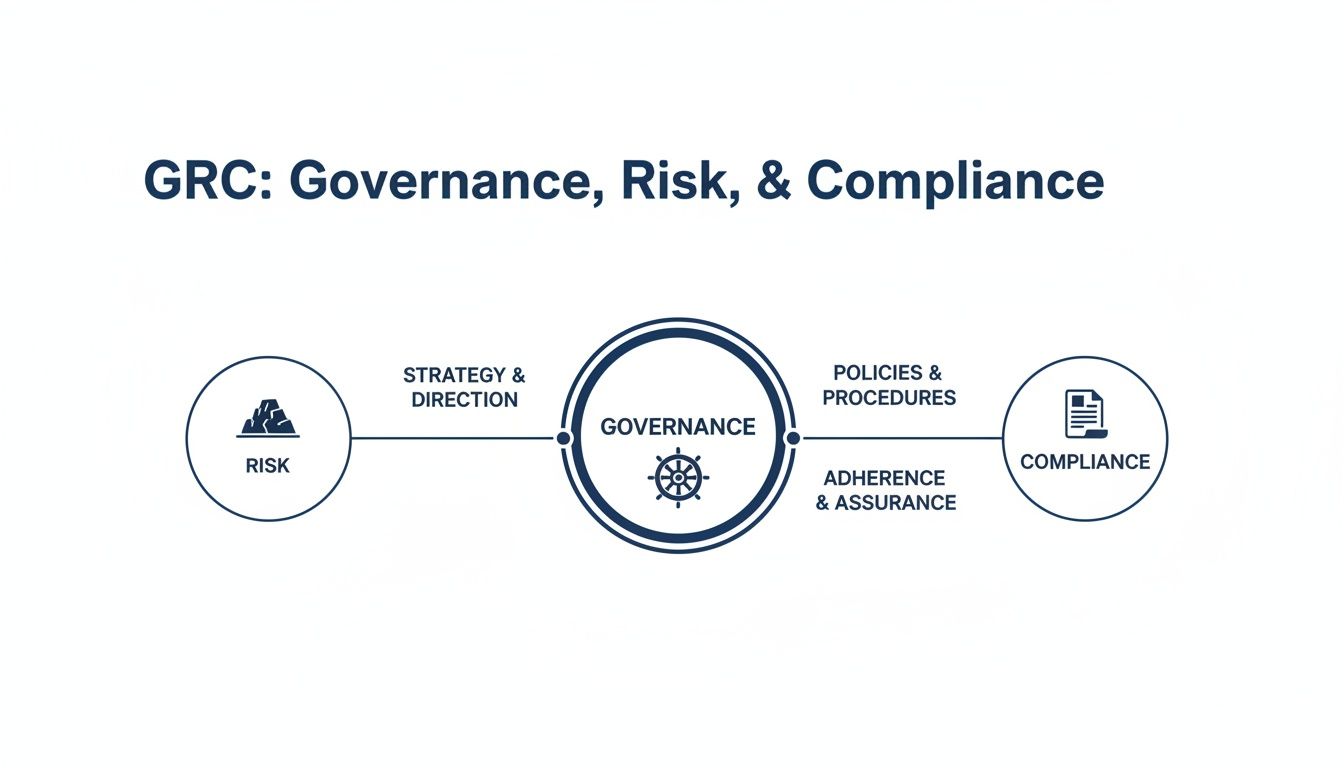
Governance provides the direction, Risk Management spots the roadblocks, and Compliance makes sure you follow the rules. Now, let’s break down what each one looks like in practice.
The Governance Pillar: The Strategic Compass
Governance is where it all starts. This pillar belongs to the board and senior leadership, who are responsible for setting the organisation's direction and establishing the 'tone from the top'. At its core, governance is all about control and oversight.
Key activities within the Governance pillar include:
- Defining Corporate Objectives: Setting clear, measurable business goals that steer everything the organisation does.
- Setting Risk Appetite: Deciding how much and what type of risk the business is willing to take on to achieve its goals. This is a critical strategic decision.
- Establishing Policies: Creating the high-level rules that govern behaviour, from data handling protocols to codes of ethical conduct.
- Creating Accountability: Defining who owns what. Clear roles, responsibilities, and reporting lines ensure that someone is accountable for every critical function and outcome.
In short, Governance is the 'why' behind your operations. It sets the guardrails, making sure every action taken across the business lines up with your strategic goals and ethical values.
For Australian directors, strong governance is no longer just good practice; it is a matter of personal liability. Regulators are increasingly focused on board-level accountability for security failures.
The Risk Management Pillar: The Proactive Shield
Once Governance sets the strategic direction, the Risk Management pillar kicks in. Its job is to find, assess, and treat any threats that could stop the organisation from reaching its objectives. It’s all about being proactive and looking ahead.
And this goes far beyond just cybersecurity. A proper risk management function in Australia looks at a whole spectrum of potential threats:
- Cyber Threats: Ransomware, data breaches, and sophisticated phishing attacks.
- Operational Risks: Things like system failures, human error, or broken processes.
- Supply Chain Risks: Disruptions caused by third-party vendors and partners.
- Regulatory Risks: The potential for fines or sanctions from failing to comply.
The process involves methodically analysing how likely these risks are and what impact they could have, then creating strategies to manage them. That might mean putting in new security controls, changing a business process, or transferring the risk through insurance. For a deep dive into this process, many organisations follow established standards. You can learn more in our guide on the ISO 31000 risk management framework.
The Compliance Pillar: The Rulebook
Finally, we have Compliance. This is the most externally-focused of the three pillars, making sure the organisation follows all its mandatory obligations. It answers the simple question: "Are we following the rules?"
The 'Compliance' pillar ensures your organisation adheres to all relevant laws, regulations, and industry standards, a critical aspect of overall security compliance. For an Australian business, this involves navigating a complex web of requirements:
- Legislation: Such as the Privacy Act 1988 and its Notifiable Data Breaches (NDB) scheme, and the Security of Critical Infrastructure (SOCI) Act.
- Industry Standards: Mandates like the Payment Card Industry Data Security Standard (PCI DSS) for any business handling card payments.
- Frameworks: Best-practice guidelines like the ASD's Essential Eight, which are fast becoming a non-negotiable for government suppliers.
Compliance is all about proving you are doing what you say you are doing. This means collecting evidence, running audits, and generating reports to show regulators, auditors, and customers that you are meeting your obligations.
When you integrate it properly with Governance and Risk, compliance stops being a frantic, last-minute activity and becomes a natural result of a well-run business.
Why a GRC Framework is Critical for Australian Business
The idea of what is governance risk and compliance often feels abstract, but Australia’s demanding regulatory climate has made it an immediate commercial priority. For years, many organisations got by treating compliance like a periodic box-ticking exercise. That approach is no longer just outdated—it is a direct threat to business survival.
The pressure is coming from all sides. Core laws like the Security of Critical Infrastructure (SOCI) Act and the Notifiable Data Breaches (NDB) scheme now have real teeth. At the same time, frameworks like the ASD's Essential Eight are shifting from 'good ideas' to non-negotiable requirements for winning government contracts.
This reality demands a fundamental change in how we think about security. A proactive GRC programme isn't about passing the next audit. It's about moving your organisation to a state of continuous defence.
The Intensifying Regulatory Clampdown
The days of light-touch enforcement are well and truly over. Australian regulators, especially the Australian Securities and Investments Commission (ASIC), are taking a much harder line on governance failures. This has created a new environment where accountability for leaders is personal and the consequences are severe.
This isn't just a feeling; it's a documented trend. We saw regulatory enforcement escalate dramatically with ASIC’s high-profile actions against companies in 2024, setting the stage for even stricter crackdowns. Lawmakers are also spinning up a dense and complex web of rules, passing 283 bills at the Commonwealth level and 371 in New South Wales alone during 2024. As fines rise and directors face unprecedented personal liability, leaders must find a way to ensure continuous compliance.
This new era of enforcement means that demonstrating robust governance, risk, and compliance practices is no longer just about protecting the company. It’s about protecting its leaders from personal legal and financial jeopardy.
Beyond Fines: The Broader Commercial Impact
While regulatory penalties are a huge driver, the business case for GRC goes far beyond just avoiding fines. In today's climate, investors, partners, and customers are all looking much more closely at an organisation's security and governance posture.
A single data breach or a public compliance failure can cause immediate and lasting damage.
- Reputational Harm: Customer trust, once you lose it, is incredibly hard to get back. A major security failure can wipe out years of brand-building in a single day.
- Loss of Competitive Advantage: In many procurement processes, proving strong GRC through certifications like ISO 27001 or SOC 2 is no longer a differentiator. It is the price of entry.
- Investor Scepticism: Sophisticated investors now see poor GRC as a clear red flag. To them, it signals operational weakness and a direct risk to their investment.
This scrutiny isn't confined to Australia. Global regulations like the GDPR compliance framework show how critical strong data protection has become for any business with international customers or operations.
From Burden to Business Advantage
This is where a well-structured GRC programme really proves its worth. By integrating governance, risk, and compliance activities, organisations can turn what feels like a regulatory headache into a clear business advantage.
Instead of scrambling before an audit, a proactive GRC approach gives you a real-time, evidence-backed view of your security posture. This state of continuous audit-readiness brings enormous benefits. Furthermore, it can speed up sales cycles by giving you ready-made proof of compliance for enterprise deals. It also gives the board the assurance it needs to pursue ambitious growth strategies with confidence.
Understanding the threat landscape is a key part of this proactive stance. As the latest government reports show, the cyber threats facing Australian businesses are both persistent and constantly evolving. You can read our summary of the ASD Cyber Threat Report to get a better handle on the specific risks. A strong GRC framework gives you the structure to manage these threats systematically, transforming security from a reactive cost centre into a strategic enabler that both protects and creates value.
Your Practical Roadmap to Implementing a GRC Framework
Understanding the theory behind what is governance risk and compliance is one thing; putting it into practice is another challenge entirely. Building an effective GRC framework isn't a single project with a finish line. It is an ongoing programme that requires a structured approach built on three core pillars: People, Process, and Technology.
Moving from theory to a resilient, operational GRC programme requires a clear plan. For IT managers and compliance leaders, this roadmap provides a straightforward blueprint for building organisational resilience one step at a time, breaking the journey down into manageable components.
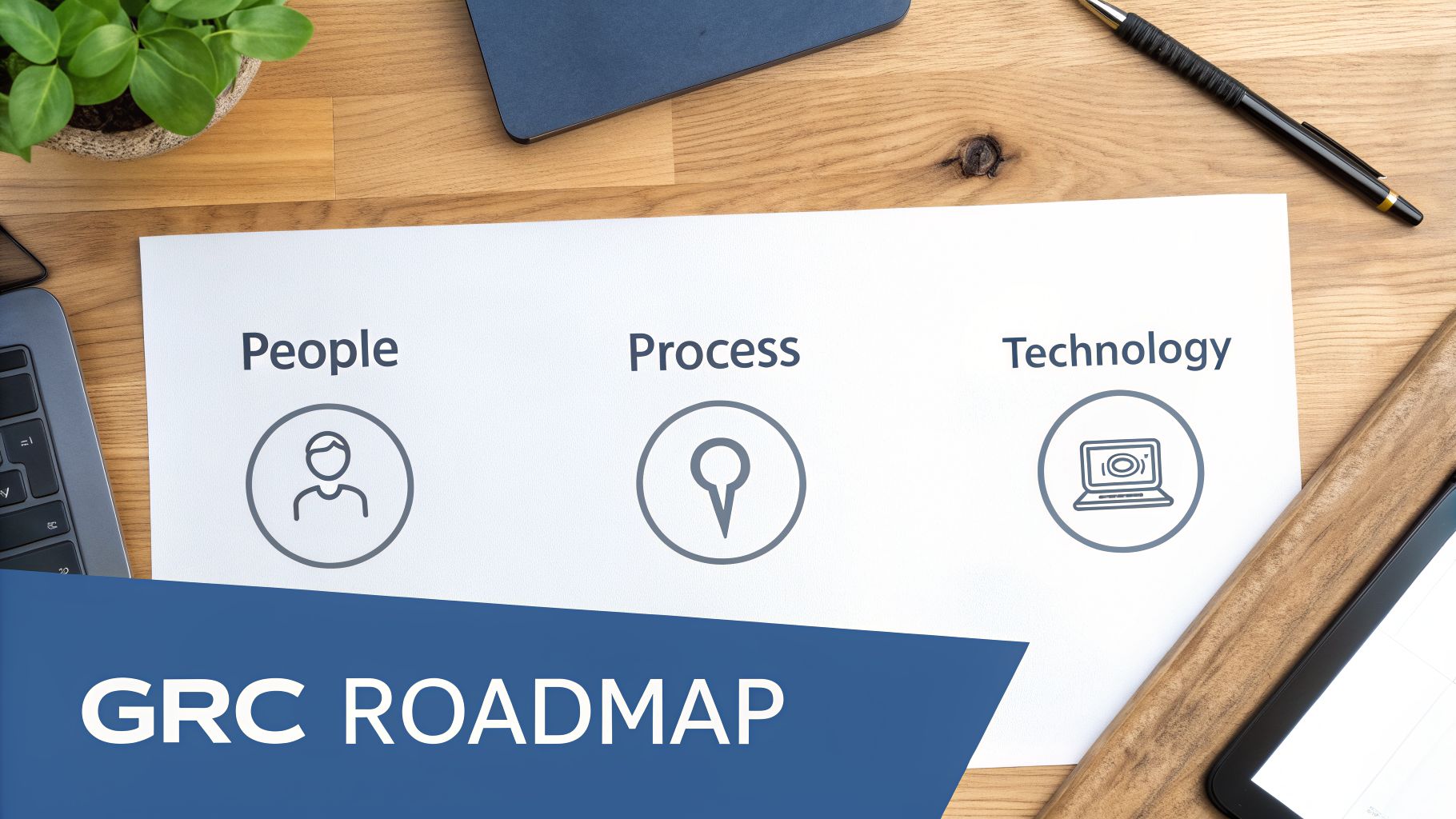
Let’s explore how each of these pillars contributes to a successful GRC implementation that actually works in the real world.
Phase 1: People and Culture
Technology and processes are crucial, but a GRC framework will ultimately fail without the right people and a supportive culture. The ‘people’ component is about embedding risk awareness into your organisation’s DNA, making it everyone’s responsibility, not just the IT department's problem.
The goal here is to foster a security-first mindset. This starts from the top down, with leadership visibly championing the importance of GRC.
Key actions for this phase include:
- Define Roles and Responsibilities: Clearly document who is accountable for what. This includes appointing a risk committee, assigning control owners, and ensuring every employee understands their role in protecting the business.
- Foster a Security-Aware Culture: Implement ongoing security awareness training that goes beyond annual box-ticking. Furthermore, use phishing simulations and regular security bulletins to keep cybersecurity top of mind for everyone.
- Establish Cross-Functional Collaboration: GRC is not an IT-only initiative. Create channels for regular communication between IT, legal, finance, and operations to ensure a unified approach to risk.
A strong security culture transforms your workforce from a potential vulnerability into your first line of defence. When employees feel a sense of ownership over security, they are far more likely to report suspicious activity and adhere to policies.
Phase 2: Documenting the Process
With the right people in place, the next step is to formalise your processes. This pillar is about creating the repeatable, documented procedures that form the backbone of your GRC programme. Subsequently, it turns abstract goals into concrete, auditable actions.
Your GRC processes should provide a clear and consistent method for identifying, assessing, managing, and monitoring risks across the organisation.
A robust GRC process involves several key steps:
- Conduct a Risk Assessment: First, begin by identifying and cataloguing the specific risks your organisation faces, considering everything from cyber threats and regulatory changes to operational failures.
- Establish a Control Framework: Next, map your identified risks to a set of controls. You can adopt established frameworks like ISO 27001, the ASD Essential Eight, or NIST to guide this process and avoid reinventing the wheel.
- Develop an Incident Response Plan: No defence is perfect. A documented incident response plan ensures you can react quickly and effectively when a security event occurs, minimising damage and ensuring you meet your NDB scheme obligations.
- Implement Continuous Monitoring: Finally, don't wait for the annual audit. Establish processes for continuously monitoring the effectiveness of your controls and tracking your risk posture in real time.
For leaders looking for more detail, we offer a comprehensive guide to building a cyber security GRC programme that dives deeper into these processes.
Phase 3: Implementing Technology
The final pillar is technology. While spreadsheets can work for very small organisations, they quickly become unmanageable as complexity grows. Therefore, modern GRC platforms are essential for automating processes, managing evidence, and providing real-time visibility.
The right technology acts as a force multiplier, making your GRC programme more efficient, accurate, and scalable. It underpins your people and processes with a powerful engine for data aggregation and reporting.
As Australian organisations increasingly recognise the limitations of manual GRC, the market for specialised platforms is growing significantly.
Australian GRC Technology Market Growth
| Year | Market Value (USD Billion) | Projected CAGR |
|---|---|---|
| 2024 | $1.4 | – |
| 2025 | $1.6 | 13.5% |
| 2026 | $1.8 | 13.5% |
| 2027 | $2.1 | 13.5% |
This trend highlights a clear shift: relying on technology is no longer a luxury but a necessity for effective GRC management.
GRC platforms are particularly crucial for:
- Automating Control Verification: Technology can automatically test controls and collect evidence, drastically reducing the manual effort required for audits.
- Streamlining Reporting: Generating reports for frameworks like SOC 2, IRAP, and PCI DSS becomes a streamlined process, allowing you to demonstrate compliance on demand.
- Delivering a Real-Time Risk View: Dashboards provide leaders with an up-to-the-minute view of the organisation’s risk posture, enabling faster, data-driven decision-making.
By methodically addressing People, Process, and Technology, you can build a GRC framework that is not only compliant but also a strategic asset for building business resilience.
Achieving Continuous Defence with Embedded GRC
A theoretical GRC framework is a great start, but its real value only appears when you put it into action. Operationalising GRC means moving beyond periodic checklists and toward a state of continuous defence. This is where your governance policies, risk management activities, and compliance obligations are not just documented but actively embedded into your daily security operations.
For many Australian organisations, especially those without a full-time, dedicated Chief Information Security Officer, strategic oversight can be a major gap. A Virtual CISO (vCISO) service becomes invaluable here, providing the senior-level Governance needed to steer the ship. A vCISO helps set the risk appetite, translates board-level objectives into actionable security policies, and ensures your security program aligns with business goals.
Embedding Proactive Risk Management
With strong governance providing direction, proactive Risk Management becomes your forward-looking radar. This isn’t about waiting for an incident to happen; it’s about actively hunting for weaknesses and threats before they can be exploited. You achieve this by integrating key security services directly into your GRC program.
Two of the most critical components are:
- Managed Detection and Response (MDR): Think of MDR as your 24/7 security team. It continuously monitors your networks, endpoints, and cloud environments for signs of malicious activity. When a potential threat is detected, the MDR team immediately investigates, contains, and neutralises it, drastically reducing the impact of an attack.
- Penetration Testing: While MDR provides constant monitoring, penetration testing offers a focused, adversarial assessment. Ethical hackers simulate real-world attacks to identify vulnerabilities in your systems and processes. This gives you a clear, prioritised list of weaknesses to fix before a real attacker finds them.
By embedding MDR and regular penetration testing into your risk management processes, you shift from a passive, reactive stance to an active, predictive one. You are no longer just hoping you are secure; you are constantly testing that assumption.
Automating Continuous Compliance
The final piece is making Compliance an ongoing, automated outcome rather than a frantic, last-minute project. Traditional audits are point-in-time snapshots that are expensive, disruptive, and quickly become outdated. Automated compliance platforms change this dynamic entirely.
The drive towards integrated risk management is fuelling an explosion in the Australian GRC platform market, which is projected to grow at a 10.50% CAGR from USD 1.4 billion in 2024 to USD 3.7 billion by 2033. For forward-thinking organisations, this trend signals a critical shift from reactive audits to continuous validation. By using automated tools, you can explore the data showing how GRC platforms transform compliance into a competitive advantage.
These platforms connect directly to your IT environment and automatically gather evidence to verify that your controls are working as intended. This keeps you perpetually audit-ready for standards like:
- ISO 27001
- SOC 2
- PCI DSS
Instead of spending weeks gathering screenshots and logs for an auditor, you can generate real-time reports with a few clicks. This not only dramatically cuts the cost and effort of audits but also provides the board with constant assurance that the organisation is meeting its obligations. This continuous validation transforms compliance from a costly burden into a strategic asset, maximising your security ROI.
How to Measure the Success of Your GRC Programme
A GRC programme is only as good as the value it delivers. To secure ongoing investment from the board, CISOs and IT leaders must demonstrate effectiveness with clear, commercially relevant metrics. Measuring success isn’t about abstract scores; it’s about linking security efforts directly to tangible business outcomes and proving a return on investment.
A successful programme moves beyond simply ticking compliance boxes. It provides quantifiable proof that you are actively reducing risk, improving operational efficiency, and strengthening the organisation’s overall resilience.
Key Performance Indicators for GRC
To build a compelling business case, focus on Key Performance Indicators (KPIs) that leadership understands. These metrics should tell a story of progress, connecting your GRC activities to financial and operational improvements. Vague assurances are no longer enough; data-driven proof is essential.
Essential KPIs for your GRC dashboard include:
- Reduction in Audit Findings: Track the number and severity of findings from one audit period to the next. A consistent downward trend is powerful evidence that your controls are improving and becoming more effective.
- Time and Cost Saved on Audits: Measure the person-hours and external costs associated with preparing for and undergoing audits. Automation through GRC platforms should lead to a significant decrease in this figure over time.
- Number of Critical Risks Mitigated: Report on how many high-priority risks identified in your risk register have been successfully addressed or reduced to an acceptable level. This shows proactive risk management in action.
These KPIs directly translate security work into business language. They shift the conversation from technical details to strategic impact, making it easier to justify budgets and resources. You can read more about how the right GRC tools help organisations compare use cases and achieve these efficiencies.
The ultimate goal is to quantify the value of moving from a reactive, audit-focused posture to one of continuous defence. When you can show the board that your GRC programme not only prevented a potential fine but also saved hundreds of hours in audit preparation, you are speaking their language.
Measuring Cyber Defence Effectiveness
In addition to audit and risk metrics, it’s crucial to measure how well your GRC programme improves your real-world cyber defences. Metrics related to incident response show how quickly and effectively your team can handle security events, directly reflecting the maturity of your programme.
Key cyber defence metrics to track are:
- Mean Time to Detect (MTTD): How long does it take for your team to identify a security threat? A lower MTTD indicates stronger monitoring and detection capabilities.
- Mean Time to Respond (MTTR): Once a threat is detected, how quickly is it contained and neutralised? A falling MTTR demonstrates improved incident response processes.
Frequently Asked Questions About GRC in Australia
Even with a clear GRC roadmap, practical questions always come up. Here are direct answers to the common queries we hear from Australian IT and security leaders who are getting their programmes off the ground.
GRC vs Risk Management What Is the Difference?
This is a frequent point of confusion. The simplest way to think about it is that Risk Management is a critical part of GRC, but GRC is the much wider, integrated strategy.
Risk management focuses on the tactical work of identifying, assessing, and treating threats. GRC is the strategic framework that connects those activities back to high-level Governance (the organisation’s goals and policies) and ensures everything aligns with its Compliance obligations.
Essentially, GRC provides the ‘why’ and the ‘how’ for the ‘what if’ of risk management.
What Does a GRC Implementation Cost an Australian SME?
There’s no single price tag, as the cost depends on your organisation’s size, complexity, and the specific regulations you need to meet. For a small to medium-sized enterprise (SME), however, the investment is usually far more manageable than leaders fear, especially when weighed against the cost of a data breach or a regulatory fine.
Costs generally fall into a few key areas:
- Advisory and Implementation: This covers the expertise needed to build your framework, run initial risk assessments, and guide you through any certifications.
- Technology: These are the subscription costs for a GRC platform that automates the repetitive, manual work.
- Internal Resources: This is the time your own team will invest in the process.
Many firms offer fixed-cost packages for specific goals, like achieving ISO 27001 certification, which gives you cost certainty. The key is to see GRC not as a cost centre, but as an investment in resilience and market advantage.
Is a GRC Platform Necessary or Can We Use Spreadsheets?
For a brand-new startup with very little complexity, spreadsheets can work as a temporary starting point. However, they become a serious liability almost immediately. Spreadsheets are entirely manual, prone to human error, create data silos, and offer zero real-time visibility or automation.
As soon as you start managing more than one regulatory framework or a handful of critical risks, spreadsheets become completely unscalable. They simply cannot support the continuous monitoring and audit-readiness that a modern GRC programme requires. A dedicated platform is essential for any organisation serious about managing risk effectively.
How Does GRC Help with Board-Level Reporting?
This is one of the most powerful business benefits of a mature GRC programme. Instead of burying the board in dense, technical reports, a GRC platform translates complex security data into clear, business-focused dashboards.
This allows CISOs and security leaders to:
- Visually show the organisation’s risk posture against its defined appetite.
- Demonstrate clear progress in mitigating critical risks over time.
- Provide real-time proof of compliance with key regulations.
- Quantify the ROI of security spending through metrics like reduced audit costs and fewer incidents.
Ultimately, GRC gives the board the assurance it needs to make strategic decisions with confidence.
Ready to move from periodic audits to a state of continuous, proactive defence? The specialists at CyberPulse deliver end-to-end GRC support, combining automated controls and tailored strategies to keep you perpetually audit-ready. Learn how we can help you build a resilient, future-ready security programme at https://www.cyberpulse.com.au.
Browse to Read Our Most Recent Articles & Blogs
Subscribe for Early Access to Our Latest Articles & Resources
Connect with us on Social Media