This article provides a guide to the SMB1001 framework. Cyber attacks now hit Australian...
Your Guide to a Resilient Information Security Policy

First Published:
March 30, 2026
Content Written For:
Small & Medium Businesses
Large Organisations & Infrastructure
Government
Read Similar Articles
How to defend against Infostealer Malware
Infostealer malware is not just another cyber threat. It is a silent data thief designed to...
A Guide to NIST Cybersecurity Framework Implementation
Getting a NIST Cybersecurity Framework implementation right is a strategic project, not just a...
What Is an Intrusion Test? A Guide for Australian Businesses
An intrusion test is an authorised, simulated attack on your organisation's systems, networks, or...
What is Endpoint Detection and Response?
Think of Endpoint Detection and Response (EDR) as an elite security detail for every single device...
An information security policy is the foundational document that outlines your organisation’s rules for protecting its data, systems, and digital assets. It acts as a high-level directive, setting out the principles everyone must follow to maintain security and ensure compliance. Therefore, this policy is not just a technical document for the IT team; it is a strategic business asset.
Why Your Security Policy Is a Business Enabler
It is easy to see an information security policy as just another compliance checkbox. For Australian CIOs and CISOs, however, it is time to reframe the policy as a strategic asset that builds business resilience and enables growth. A well-written policy is a cornerstone of corporate governance, delivering real commercial outcomes that go far beyond technical controls.

Think of the policy as the constitution for your digital operations. It provides a clear framework that lets your business innovate and adopt new technologies with confidence. In doing so, it protects revenue streams, strengthens your brand, and builds the customer trust that is so critical in a competitive market.
This proactive approach to security is mirrored in market trends. For instance, Australian cybersecurity spending is at an all-time high, with organisations nationwide expected to invest over AU$7.5 billion in information security during 2026. This huge financial commitment, a 9.5% increase from 2025 shows that Australian businesses realise strong policies are essential for continuity.
From Risk Mitigation to Revenue Protection
A strong policy directly connects security work to business value. It creates a secure environment that enables your organisation’s strategic goals, rather than hindering them. This connection is vital for gaining executive support and company-wide buy-in.
Furthermore, a well-structured security policy can contribute directly to business objectives beyond purely technical metrics.
Core Business Objectives of an Effective Security Policy
| Business Objective | How the Policy Contributes |
|---|---|
| Enhance Market Competitiveness | A certified and well-communicated security posture acts as a key differentiator, especially in regulated sectors like finance and healthcare. |
| Build Stakeholder Confidence | It demonstrates due diligence to investors, partners, and regulators, assuring them that risks are being managed effectively. |
| Support Digital Transformation | It provides a safe foundation for adopting cloud, IoT, and AI, ensuring innovation does not introduce unacceptable risk. |
| Strengthen Brand Reputation | By preventing data breaches and protecting customer data, it safeguards your brand—one of your most valuable intangible assets. |
This table shows how a policy moves security from a cost centre to a function that actively protects revenue and shareholder value.
A great policy transforms security from a cost centre into a function that actively protects revenue and shareholder value. It serves as the single source of truth that aligns technology, people, and processes toward a common goal of cyber resilience.
The policy is also your primary tool for creating a security-aware culture. When every employee understands their role in protecting sensitive information, the organisation’s collective defence becomes significantly stronger. Ultimately, this cultural shift is a critical part of any modern cyber security strategy. Your policy empowers your team to operate securely and efficiently, making it an indispensable driver of sustainable growth.
Building the Core Components of Your Policy
Think of your information security policy as the architectural blueprint for your cyber defences. Without a clear and comprehensive plan, your security efforts will be disconnected, reactive, and almost impossible to enforce consistently across the business.
This blueprint needs a solid foundation. The initial sections of your policy set the tone for the entire document, defining its authority and boundaries. They ensure everyone, from the board down, understands the policy’s purpose from the very first page.
Laying the Foundational Stones
First, you need to establish the policy’s core purpose, scope, and objectives. These are not just formalities; they are the strategic anchors for your entire information security programme.
- Policy Statement and Purpose: This is a high-level declaration of intent, typically from senior leadership. It confirms the organisation’s commitment to information security and briefly states why the policy exists—to protect assets, meet legal obligations, and maintain trust.
- Scope: This section clearly defines who and what the policy applies to. It should cover all employees, contractors, third-party vendors, systems, data, and facilities. A well-defined scope prevents confusion and guarantees consistent application.
- Security Objectives: These are the specific, high-level goals your policy aims to achieve. They almost always link directly to the classic CIA triad: Confidentiality (preventing unauthorised disclosure), Integrity (ensuring data accuracy), and Availability (guaranteeing access when needed).
Once these foundational elements are in place, you can move on to the more granular, operational parts of the policy. These sections translate your high-level goals into actionable rules and clear responsibilities.
Defining Roles and Asset Governance
For a policy to be effective, accountability must be crystal clear. Every person in the organisation needs to understand their specific security obligations, from the CEO to the newest hire. This section assigns ownership and sets the ground rules for using company assets.
Example Clause: Roles and Responsibilities
“The Chief Information Security Officer (CISO) holds ultimate responsibility for the implementation and maintenance of this policy. All employees are responsible for adhering to the policy’s principles in their daily activities and for reporting any suspected security incidents immediately to the IT helpdesk.”
This clarity is crucial. Next, your policy must define the rules of engagement for all digital and physical assets through an Acceptable Use Policy (AUP). This component outlines what is considered appropriate and inappropriate behaviour when using company resources like laptops, networks, and software.
Another critical piece of asset governance is a robust process for data classification. This framework is essential for applying the right level of protection to the right information. You can see how this feeds into broader security evaluations by reading our guide on how to conduct a risk assessment.
Structuring Data Protection and Incident Response
Effective data protection is not a one-size-fits-all approach. It requires a structured way to classify and handle information based on its sensitivity. A typical data classification scheme might include categories like:
- Public: Information cleared for public release.
- Internal: Data for internal business use that would not cause material harm if disclosed.
- Confidential: Sensitive information, like business plans, that could cause moderate damage if leaked.
- Restricted: Highly sensitive data, such as personally identifiable information (PII), that would cause significant harm if disclosed.
For each classification level, your policy must specify handling requirements, like encryption standards, access controls, and secure disposal methods. When it comes to secure disposal, integrating verifiable standards is a smart move.
Finally, no information security policy is complete without a dedicated incident response section. This component outlines the formal plan for detecting, containing, and remediating security incidents, ensuring a swift, coordinated reaction to minimise damage and return to business.
Aligning Your Policy With Australian Frameworks
A security policy that lives in a drawer, disconnected from real-world compliance needs, is not just useless—it is a liability. For Australian organisations, a policy must do more than just state internal rules. It has to be the central document that proves you are meeting multiple, often overlapping, compliance frameworks.
The key is to stop treating standards like ISO 27001, PCI-DSS, and the ASD Essential Eight as separate checklists. Instead, a smarter approach is to build a unified policy where one well-written clause can satisfy requirements across several frameworks. This integrated method cuts down on administrative work, prevents conflicting controls, and creates a single source of truth for every audit.
This is not about just collecting documents. It is about turning your policy into a cohesive governance engine.
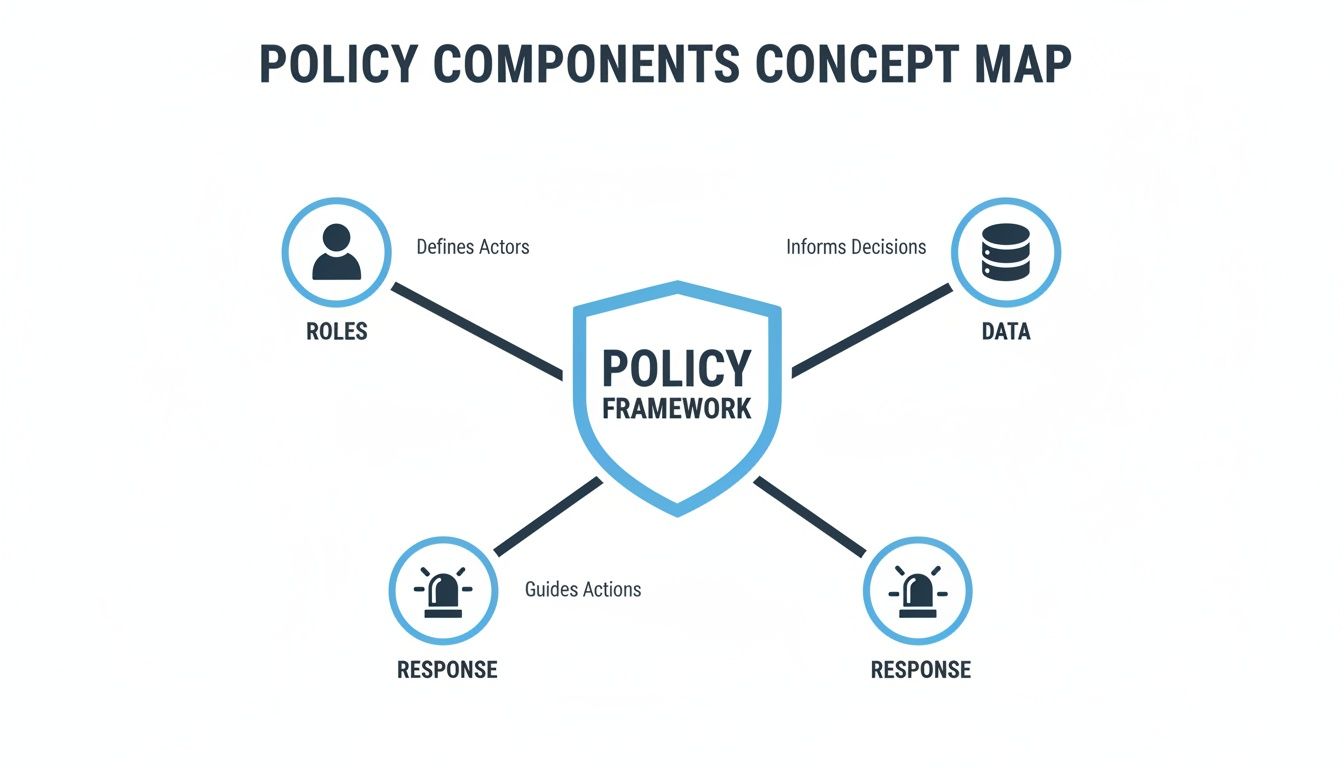
As you can see, core components like accountability (Roles), asset protection (Data), and crisis readiness (Response) are all interconnected. Effective security depends on how these pieces work together, and your policy is what holds them in place.
Mapping Policy Clauses to Australian Compliance Frameworks
To make this practical, the table below shows how common policy sections map directly to controls in major frameworks relevant to Australian businesses. Instead of writing separate rules for each standard, you can craft a single clause that satisfies multiple obligations at once.
| Policy Section | ISO 27001 Control | PCI-DSS Requirement | ASD Essential Eight Strategy |
|---|---|---|---|
| Access Control | A.5.15, A.5.18 | Req 7 | Restrict administrative privileges |
| Data Encryption | A.8.24 | Req 3 | N/A |
| Patch Management | A.8.8 | Req 6.2 | Patch applications and operating systems |
| Incident Response | A.5.24, A.5.26 | Req 12.10 | N/A |
| Backup and Recovery | A.8.13 | N/A | Regular backups |
This cross-referencing approach does not just make auditors happy; it gives your security and compliance teams a clear, unified view of your control environment. Consequently, it simplifies everything.
The ASD Essential Eight
For any organisation working with the government, the Australian Signals Directorate’s (ASD) Essential Eight is non-negotiable. For everyone else, it is simply best practice. Therefore, your information security policy must explicitly require and support the implementation of these eight mitigation strategies.
For example, your access control section should not just talk vaguely about permissions. It needs to directly enforce the Principle of Least Privilege, a cornerstone of the Essential Eight. Similarly, policy clauses on software must mandate application control and timely patching, while data handling rules must require robust, tested backups.
An effective policy translates the Essential Eight’s technical guidelines into clear, enforceable business rules. It elevates these strategies from an IT checklist to organisation-wide mandates that everyone understands, implements, and is audited against.
This top-down enforcement gets results. For instance, Commonwealth government entities now report that 90% have formal incident response plans and 82% have established comprehensive cyber security strategies, thanks to mandatory frameworks like the Essential Eight and the PSPF.
Integrating ISO 27001 and PCI-DSS
For organisations handling sensitive customer information or chasing international contracts, ISO 27001 and the Payment Card Industry Data Security Standard (PCI-DSS) are critical. The good news is their requirements map cleanly to a well-structured policy, helping you avoid “death by a thousand audits.”
Let us look at a few examples of how this works in practice:
- A single Access Control section in your policy can satisfy ISO 27001’s A.5 controls, PCI-DSS Requirement 7 (“Restrict access to cardholder data by business need to know”), and the Essential Eight’s “Restrict administrative privileges” strategy all at once.
- A Data Encryption clause can address both ISO 27001’s A.8 controls on cryptography and PCI-DSS Requirement 3 (“Protect stored cardholder data”).
- An Incident Response chapter can fulfil ISO 27001’s A.5 incident management controls and PCI-DSS Requirement 12.10 (“Implement an incident response plan”).
This unified mapping is a powerful tool for your CISO and compliance teams. It clarifies accountability and provides a holistic view of your security posture. For a deeper dive into government-specific frameworks, our guide on the Australian Government Information Security Manual is a great next step.
By aligning your policy clauses with these key frameworks from the very beginning, you create a robust, defensible, and highly efficient compliance programme that proves your commitment to security.
From Draft to Deployment: A Practical Roadmap
Taking an information security policy from a blank page to a living part of your organisation is not something you can rush. It requires a structured approach that involves the whole business, not just the IT department. Getting from draft to deployment is a journey with clear phases, and each one is critical for creating a policy that actually works and can be enforced.

First, the real step is pulling together a cross-functional policy committee. This group will steer the entire process, making sure the final document is practical for everyone, not just the security team.
Your committee needs people from across the business, including:
- IT and Security: For the technical context and understanding of the threat landscape.
- Legal and Compliance: To ensure the policy aligns with Australian regulations and contractual promises.
- Human Resources: To advise on training, employee matters, and how to handle non-compliance.
- Operations and Business Units: To ground the policy in the reality of how people work day-to-day.
This kind of collaboration is what stops you from creating a policy that looks great on paper but falls apart in practice.
Phase 1: Discovery and Risk Assessment
Before you write a single word, the committee needs to understand exactly what risks your organisation is up against. This discovery phase is all about identifying your most important information assets, figuring out where they are, and what threats they face. A formal risk assessment gives you the evidence you need to justify the controls you put in your policy.
Without this upfront analysis, your policy is just guesswork. This stage is absolutely critical because it shapes the entire document, ensuring your controls are proportional to the risks you actually face. For a deeper dive, it is worth understanding how this fits into a broader cybersecurity roadmap as a practical framework for Australian organisations.
Phase 2: Drafting and Framework Alignment
Once you have a clear picture of your risks, it is time to start drafting. The main goal here is clarity. Use simple, direct language that every single employee can understand, not just the technical experts.
This is also the time to align your policy with relevant frameworks like ISO 27001 or the ASD Essential Eight. Doing this from the start ensures your policy does not just manage risk but also ticks your compliance boxes, saving you from expensive rework down the track.
Phase 3: Stakeholder Review and Executive Approval
With a solid draft in hand, it is time to circulate it for feedback. This stakeholder review is your chance to pressure-test the policy with the people who will actually have to live with it. It is how you find potential roadblocks and build support before you go live.
Executive buy-in is the single most important factor for successful policy enforcement. When the C-suite publicly champions the policy, it sends a clear message that information security is a top-level business priority, not just an IT problem.
Getting formal sign-off from your executive team or the board is the final hurdle in this phase. That approval gives the policy the authority it needs to be enforced across the entire organisation. This step is non-negotiable.
Phase 4: Communication and Training Rollout
A policy nobody knows about is completely worthless. The final phase is all about communication, training, and making sure the policy becomes part of the day-to-day. A successful rollout needs a coordinated campaign to drive awareness and understanding.
Your plan should include:
- Awareness Campaigns: Use your internal comms channels—email, Slack, intranet—to announce the new policy, explain why it matters, and point people to where they can read it.
- Mandatory Training: Develop training that is tailored to different roles. A software developer needs different guidance than someone in sales.
- Formal Acknowledgement: Put a system in place where every employee must formally state that they have read, understood, and agree to follow the information security policy.
This systematic rollout ensures your policy does not just end up forgotten on a server. It becomes a living, breathing part of your organisation’s culture, shaping secure habits and building real, lasting resilience.
Maintaining Your Policy for Lasting Resilience

An information security policy is a living document, not a project you can ‘set and forget’. Threats evolve, business priorities shift, and a static policy quickly becomes irrelevant. To prevent this, you need a robust governance model that keeps your policy effective and supports lasting cyber resilience.
This model is your framework for continuous improvement. It turns policy management from a periodic, box-ticking exercise into a strategic, ongoing function that adapts to new challenges. Consequently, it all starts with a formal, documented review schedule.
Establishing a Governance and Review Cadence
Effective policy governance needs clear ownership and a predictable review cycle. Without this structure, policies can sit untouched for years, leaving your organisation exposed to new threats and regulatory blind spots. A formal review process is a non-negotiable part of modern security management.
As a best practice, schedule a full policy review at least annually. However, a rigid yearly schedule is not enough on its own. Your policy also needs an immediate review whenever specific trigger events occur.
Key triggers for an out-of-cycle policy review include:
- A significant security incident: A major breach or even a near-miss offers critical lessons that must be fed back into your controls.
- Major business changes: Mergers, acquisitions, or launching into new markets will absolutely change your risk profile.
- New technology adoption: Rolling out new core platforms like cloud services or AI tools demands a fresh look at existing security rules.
- Changes in Australian regulations: New privacy laws or updated compliance mandates from regulators require immediate policy alignment.
This disciplined approach ensures your information security policy remains a true reflection of your organisation’s current operational reality and risk appetite.
Measuring Policy Effectiveness with KPIs
To prove your policy is actually working and to drive improvement, you must measure its effectiveness. This means moving beyond simple compliance checklists and tracking Key Performance Indicators (KPIs) that connect policy adherence to real-world security outcomes. This data-driven approach shows a return on investment and helps secure ongoing executive support.
A data-driven approach transforms policy management from a bureaucratic task into a strategic function. It provides objective proof that your security investments are reducing risk and building a more resilient organisation.
This is especially critical given the current threat environment. For instance, the Australian Signals Directorate responded to 1,200 cybersecurity incidents and received over 84,700 cybercrime reports according to the ASD 2024-25 Report, with critical infrastructure accounting for 13% of those incidents. These figures highlight the relentless pressure on Australian organisations and the need for policies that deliver measurable results. You can find more details on these persistent threats and gain a deeper understanding of the latest cyber trends in Australia from Chambers.com.
Consider tracking these practical KPIs to gauge your policy’s impact:
- Reduction in Incident Response Time: A well-understood incident response section should lead to faster detection, containment, and recovery. You can measure this by tracking the time from alert to resolution.
- Improved Audit and Compliance Scores: Successful policy implementation should result in fewer findings and higher scores during internal and external audits for frameworks like ISO 27001 or PCI-DSS.
- Higher Security Awareness Test Scores: Track metrics from your phishing simulations and training quizzes. An effective policy, backed by good training, should lead to a noticeable drop in click-rates.
- Decrease in Policy Exceptions: A well-designed, practical policy should require fewer exceptions over time. If exception requests are dropping, it is a good sign the policy aligns well with business processes.
By continuously monitoring these metrics, your CISO can give the board clear evidence of security posture improvement. This transforms the policy from a static document into a dynamic tool for active risk management, ensuring your organisation builds and maintains true cyber resilience.
Partnering for Policy and Compliance Success
Building, implementing, and maintaining a solid information security policy is a demanding, continuous process. It takes deep expertise not just in technical security controls but also in Australia’s complex regulatory environment. The path from a first draft to a fully defensible, audit-ready security programme is rarely simple, and going it alone can quickly drain your internal team’s time and focus.
This is where specialist expertise becomes a powerful shortcut. Partnering with a team of seasoned practitioners—think former CISOs and career cybersecurity experts—can fast-track your organisation’s progress. Instead of figuring out framework alignment and control implementation from scratch, you get to work with proven methodologies and real-world experience.
From Policy to Proactive Defence
A strong partnership goes beyond just writing documents. It is about embedding security into your organisation’s day-to-day operations. This means turning policy theory into practical, working controls that genuinely reduce risk and hold up under the scrutiny of auditors, regulators, and customers.
Expert guidance can help in several critical areas:
- GRC Support: Building a single governance, risk, and compliance (GRC) programme that efficiently maps your policy controls to multiple frameworks like ISO 27001, SOC 2, and the ASD Essential Eight.
- vCISO Services: Gaining executive-level strategic leadership to guide your policy development, secure board-level buy-in, and ensure your security strategy supports your business goals.
- Managed Compliance: Using automated tools and continuous monitoring to stay audit-ready, moving you away from stressful, last-minute checks and into a state of constant preparedness.
Partnering with security specialists shifts your approach from reactive compliance to proactive defence. It brings the strategic oversight and tactical execution needed to build a security programme that is not just compliant, but genuinely resilient to modern threats.
This collaborative approach helps you avoid common mistakes, speed up certification timelines, and get a better return on your security spending. When you engage with experts, you ensure your information security policy becomes the foundation of a mature, defensible, and business-focused security programme. This is especially true when implementing the wide range of specialised controls needed, which is covered further in our overview of MDR and other MSSP security services.
Ultimately, the right partnership gives you the confidence that your policy and its supporting controls are not just compliant on paper, but effective in practice.
Ready to speed up your journey from policy drafting to audit-ready compliance? Contact us for a consultation to discuss your policy and compliance needs and see how our expertise can strengthen your security posture.
Frequently Asked Questions
Even with a comprehensive guide, putting theory into practice always brings up specific questions. We have gathered some of the most common queries we hear from Australian business leaders about building and managing a robust information security policy.
How Often Should We Review Our Policy?
As a rule of thumb, your information security policy needs a formal review at least annually. This keeps it aligned with your business goals and the current threat landscape.
However, certain events should trigger an immediate review. Think of major security incidents, new Australian regulations like updates to the Privacy Act, adopting new core technologies, or big operational shifts like a merger. Treating your policy as a living document ensures your governance always reflects your real-world risk profile.
What Is the Difference Between a Policy, a Standard, and a Procedure?
It is best to think of these as a hierarchy, moving from high-level goals down to specific, on-the-ground actions. Each document has a distinct job, but they all work together.
- Policy: This is the top-level ‘what’ and ‘why’. It is a formal statement from management that sets the high-level rules. For example: “All sensitive company and customer data must be encrypted at rest and in transit.”
- Standard: This document provides the mandatory technical specifications needed to meet the policy. It sets the compulsory benchmarks everyone must follow. For example: “AES-256 is the required encryption standard for all data classified as Restricted.”
- Procedure: This is the detailed, step-by-step instruction manual. It gives staff the exact actions to take to comply with a standard. For example: “Here is the 5-step process for encrypting a file using the approved software before sharing.”
Do We Really Need a Formal Policy If We Are a Small Business?
Absolutely. Cyber threats and compliance obligations do not care about your company’s size. For a small or medium-sized enterprise (SME), a formal policy is arguably even more critical because it creates a strong defensive foundation when resources are tight.
A documented policy proves due diligence to customers, partners, and regulators, which can be a powerful competitive advantage. It also clarifies security responsibilities for your staff, which is one of the best ways to reduce the risk of human error. Frameworks like the ASD Essential Eight are scalable, and it is far easier and cheaper to build a solid information security policy early than to retrofit security after a costly breach.
For an SME, a policy is not bureaucratic overhead; it is the essential blueprint for secure growth. It provides clarity and a defensive baseline that allows the business to scale confidently without accumulating unacceptable risk.
How Do We Ensure Employees Actually Read and Follow the Policy?
Getting people to follow the policy goes way beyond just publishing the document and hoping for the best. To drive real adoption, you need a smart communication and training plan.
This means mandatory, engaging training sessions tailored to different roles, backed by a system where employees must formally acknowledge they have read and understood the policy. Most importantly, you must reinforce key security messages regularly through internal communications and even integrate policy principles into performance reviews. That is how you embed security into your company culture.
Ready to transform your policy from a document into a dynamic defence? CyberPulse delivers expert guidance to build and maintain a resilient, audit-ready security programme.
Book a no-obligation consultation with our Australian compliance experts
Browse to Read Our Most Recent Articles & Blogs
Subscribe for Early Access to Our Latest Articles & Resources
Connect with us on Social Media