How Australian organisations procure information technology has changed permanently. What was once...
Guide to ISO 31000 Risk Management in Australia
First Published:
March 23, 2026
Content Written For:
Small & Medium Businesses
Large Organisations & Infrastructure
Government
Read Similar Articles
Have I Been Hacked? A Guide for Australian IT & Risk Leaders
That sinking feeling often starts with a single, urgent question: "Have I been hacked?" For...
Securing Video Conferencing Systems for Your Organisation
The rapid shift to hybrid work has transformed video conferencing systems from a simple...
What Is Vishing? A Guide to Identifying Voice Scams
Vishing, a portmanteau of voice phishing, is a social engineering attack where criminals use the...
What is spear phishing: A 2026 guide to defending against targeted attacks
To understand what is spear phishing, think less of a wide net and more of a precision-guided...
In the Australian threat environment, a purely reactive approach to risk is no longer a viable strategy. For modern organisations looking to protect their assets, navigate regulations like the SOCI Act, and remain competitive, mastering ISO 31000 risk management is a foundational requirement for building genuine, long-term resilience.

Why ISO 31000 Is Your Strategic Advantage
Australian CIOs, CISOs, and risk leaders constantly face pressure to secure the business while proving their commercial contribution. In reality, a security posture built on reaction and compliance checklists simply will not hold up against determined attackers or shifting regulatory demands. Consequently, this is where an ISO 31000 risk management framework becomes a powerful strategic asset.
It is best to think of it not as another compliance task, but as the operating system for intelligent business decisions. It shifts your security function from simply ticking boxes to proactively defending the organisation and enabling new opportunities. By embracing its principles, you can better anticipate threats, channel resources where they matter most, and clearly connect security's value to the bottom line.
Moving Beyond Compliance to Resilience
Many security frameworks focus on what controls to implement. However, ISO 31000 is different. It provides the how—a structured and repeatable process for understanding the uncertainties that could impact your business objectives. Therefore, this is the bedrock of true organisational resilience.
A well-implemented framework gives you the confidence to answer key leadership questions:
- Are we spending our security budget on the right initiatives?
- How do we quantify and discuss our cyber risk exposure with the board?
- Are we genuinely prepared for new regulatory pressures like the SOCI Act?
ISO 31000 provides a common language for risk that bridges the gap between technical security teams and executive leadership. It shifts the conversation from isolated technical vulnerabilities to the potential impact on strategic business objectives, enabling smarter, commercially-grounded decisions.
To help you get started, the following table summarises the key components and their value from a leadership perspective.
ISO 31000 at a Glance for Australian Leaders
| Component | Description for CISOs and Risk Leaders | Primary Business Value |
|---|---|---|
| Principles | The foundational beliefs for effective risk management, such as being integrated, structured, and dynamic. | Creates a consistent risk culture and ensures risk management is part of all decision-making. |
| Framework | The organisational structures, policies, and accountabilities that support the risk management process. | Establishes clear ownership and governance, making risk management a repeatable business function. |
| Process | The step-by-step activities: establishing context, assessing risk, treating risk, and monitoring. | Provides a practical, actionable method for identifying, analysing, and managing specific risks. |
This structure ensures that risk management is not just an occasional project but becomes deeply embedded in how the organisation operates and grows.
A Roadmap for Risk Maturity
This guide is designed as a practical journey. We will break down the standard into its core parts, the principles, framework, and process and anchor it firmly in the Australian business context. Furthermore, we will show how it integrates powerfully with ISO 27001 and give you a clear implementation roadmap.
You will learn how to sidestep the common pitfalls that derail risk programs and see how expert guidance can accelerate your path to maturity. For more on aligning security with business goals, see our guide to building a cyber security strategy. Ultimately, this guide will show you how to use ISO 31000 risk management to not just protect your organisation, but to drive it forward with confidence.
Understanding the Three Pillars of ISO 31000
ISO 31000 is not a rigid checklist. Instead, it is a flexible guideline built on three connected pillars that work together to create a powerful system for managing uncertainty. Getting this structure right is the first step to building a risk program that creates and protects organisational value.
A good way to think about it is like building a house. The principles are the architectural philosophy—the core beliefs that guide every decision. The framework is the structural blueprint and foundation, providing support and shape. Finally, the process is the day-to-day construction work that brings the blueprint to life.
The Principles: Your Foundation for Value
The principles are the heart of the standard. They define what effective and efficient risk management looks like in practice. For Australian risk leaders, these principles are the bedrock of a defensible and value-driven program.
They are not abstract ideals. Rather, they are practical guides for creating a risk-aware culture.
- Integrated: Risk management cannot be a siloed function. It must be woven into everything the organisation does, from high-level strategic planning right down to daily operations.
- Structured and Comprehensive: A systematic approach ensures you identify and manage risks consistently across the entire organisation. This leads to far more reliable and repeatable outcomes.
- Customised: Your risk management approach must be tailored to your organisation’s specific context, objectives, and risk profile. A one-size-fits-all approach is a recipe for failure.
- Inclusive: Involving stakeholders at all levels brings diverse perspectives to the table. This leads to better decision-making and, just as importantly, stronger buy-in for risk treatments.
These core tenets ensure your risk management efforts move beyond a simple compliance exercise and become a genuine contributor to business success. Other principles—like being dynamic, using the best available information, and enabling continual improvement—all reinforce this strategic focus.
The Framework: The Scaffolding for Governance
If the principles are the ‘why’, the framework is the ‘how’ at an organisational level. It provides the scaffolding needed to support your risk management process, embedding it within your governance and decision-making structures. This is where leadership commitment becomes tangible.
The framework’s purpose is to integrate risk management into significant activities and functions. Its effectiveness depends on its integration into the organisation’s governance, from setting strategy to reviewing performance.
Key components of the framework include:
- Leadership and Commitment: Demonstrating unwavering support from the top and ensuring roles, responsibilities, and accountabilities are clearly defined and understood.
- Integration: Weaving risk management into existing business processes, policies, and performance management systems instead of bolting it on as an afterthought.
- Design: Understanding the organisation’s internal and external context to articulate a clear risk management policy and appetite statement.
- Implementation: Developing and actioning a risk management plan that works across the entire organisation.
- Evaluation and Improvement: Measuring the framework’s performance against its purpose and continuously adapting it to improve its value over time.
This structure transforms ISO 31000 risk management from a theoretical concept into a practical, repeatable business function.
The Process: The Engine of Risk Management
The process is the operational engine of the standard. It is the cyclical, day-to-day work you perform to manage risk. Critically, it is an iterative loop, not a linear, one-and-done project.
The steps are logical and build on each other:
- Scope, Context, and Criteria: First, define the boundaries of your risk activities and understand the external and internal environment. This is where you set the risk criteria against which all risks will be measured, a crucial step we detail in our guide on how to conduct a risk assessment.
- Risk Assessment: This is a three-part activity involving identification (what could happen?), analysis (what is the likelihood and impact?), and evaluation (do we need to act based on our criteria?).
- Risk Treatment: Based on the evaluation, you select and implement options for modifying the risk. This could mean accepting the risk, avoiding it, or implementing new controls to reduce it.
- Monitoring and Review: You must continuously monitor risks, the effectiveness of your treatments, and the framework itself to ensure everything remains relevant and effective.
- Recording and Reporting: Finally, documenting the process and its outcomes provides the transparency needed to support decision-making and demonstrate due diligence.
This continuous cycle ensures your organisation can adapt to changing threats and opportunities, making resilience an ongoing achievement rather than a final destination.
The Australian Context for ISO 31000
While ISO 31000 is a global standard, it is far from an abstract concept for Australian organisations. Its principles are deeply woven into our national regulatory and business fabric, making it a critical framework for any CISO or risk leader operating here.
Understanding this local context is essential. In fact, it is the key to building a defensible security posture and ensuring you meet your compliance obligations head-on.
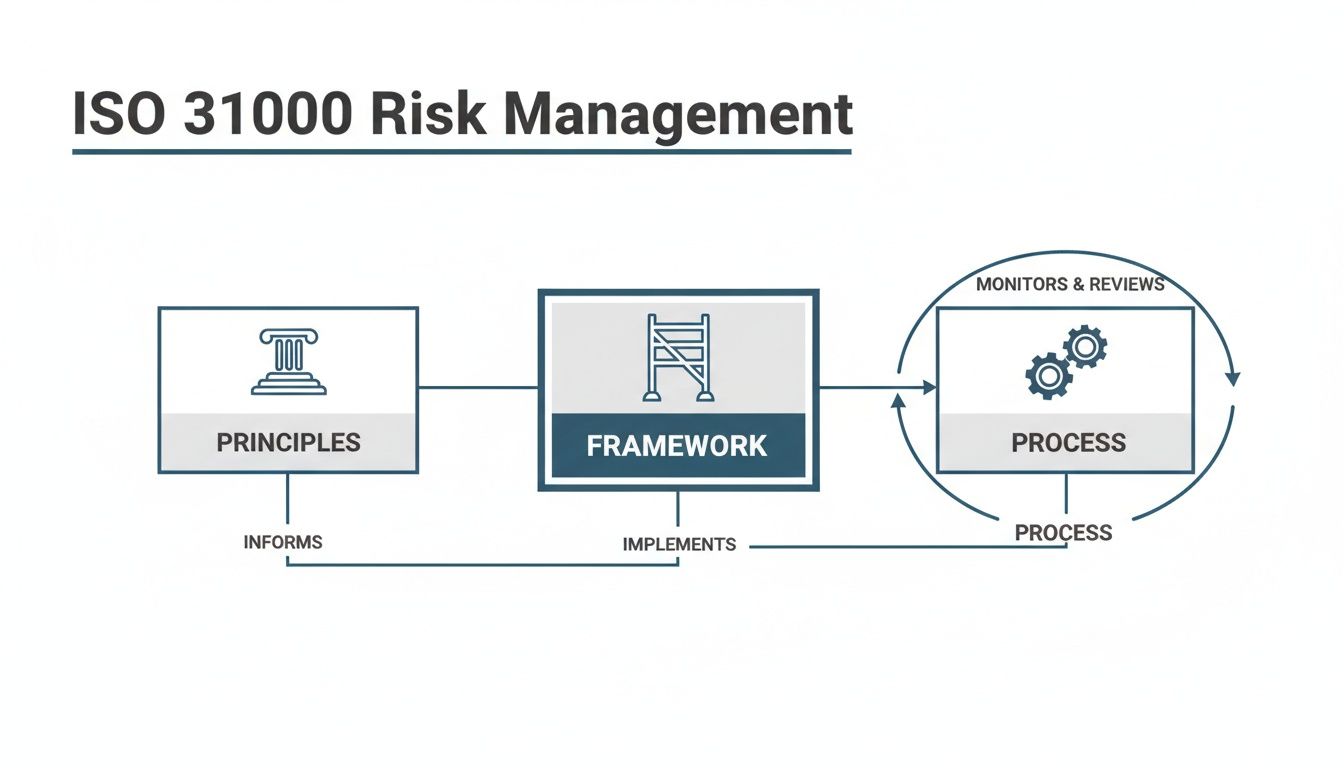
The standard’s power comes from this integrated structure. Foundational principles support the overarching framework, which in turn gives shape to the practical, day-to-day risk management process.
A Long-Standing Australian Heritage
The standard’s history in Australia is long and battle-tested. Long before the global standard existed, Australia and New Zealand pioneered enterprise risk management with the original AS/NZS 4360.
This foundational work heavily influenced the development of the international version, which was later adopted back home as AS/NZS ISO 31000. This means Australian regulators and business leaders have been working with its core concepts for decades.
It is not a new or foreign idea. It is a mature, proven methodology that has shaped how we approach risk for a generation. This gives the ISO 31000 risk management framework enormous credibility within the Australian market.
Regulatory Mandates and Strategic Alignment
For many Australian organisations, aligning with ISO 31000 is not optional. Our regulatory landscape leans heavily on its locally adopted version, AS/NZS ISO 31000:2018, as the backbone for critical frameworks.
It underpins APRA’s Prudential Standard CPS 220 for financial institutions and the Security of Critical Infrastructure Act 2018 (SOCI Act), both of which mandate risk programs that mirror its principles.
For entities regulated by the Australian Prudential Regulation Authority (APRA) and operators of critical infrastructure under the SOCI Act, aligning with ISO 31000 is a strategic imperative. Failure to do so creates significant compliance and business risk.
This requirement has become especially pronounced for critical infrastructure operators. The SOCI Act now compels a growing list of designated entities across sectors like energy, transport, and communications to adopt these methodologies.
From APRA to the SOCI Act
The influence of ISO 31000 risk management is clear across key sectors.
-
Financial Services (APRA CPS 220): APRA requires banks, insurers, and superannuation funds to maintain a risk management framework consistent with the standard. This means having a structured approach to identifying, assessing, treating, and monitoring risks. For CISOs in finance, your cybersecurity program must fit seamlessly into this broader structure.
-
Critical Infrastructure (SOCI Act): The SOCI Act requires designated entities to establish and maintain a risk management program. This program must identify hazards and implement measures to minimise or eliminate risks of an incident impacting their critical assets. The principles and process laid out in ISO 31000 provide the ideal blueprint for meeting these obligations.
By understanding these specific local drivers, Australian security leaders can more effectively justify and resource their risk management programs. For guidance on related government standards, check out our article on the Australian Government Information Security Manual.
This context shows that effective risk management is not just about good security practice—it’s about direct compliance with Australian law.
Implementing ISO 31000 and Integrating with ISO 27001
Knowing the theory behind risk management is one thing. However, putting it into practice is where most organisations get stuck. This is especially true when you are trying to connect the broad principles of ISO 31000 risk management with a specific Information Security Management System (ISMS) like ISO 27001.
Think of it this way: ISO 27001 tells you what you need to do—conduct a risk assessment. Conversely, ISO 31000 gives you the playbook for how to do it properly. It provides a structured, repeatable method that turns your risk assessment from a guess into a calculated process.
Building the Bridge Between Frameworks
Integrating these two standards is not just about ticking a box; it creates a powerful combination. While ISO 27001 mandates that you identify, analyse, and treat information security risks, it is not prescriptive about the exact method. Consequently, this is where the ISO 31000 process—establishing context, assessing risk, and treating risk—fits perfectly.
Using ISO 31000 as the engine for your ISMS risk assessment makes your approach consistent and defensible. In effect, it elevates your compliance programme from a procedural chore into a genuine business enabler that strengthens your entire security posture.
This is not a new idea in Australia. The structured approach of ISO 31000 has become a cornerstone of risk practices, especially in government. In fact, by 2020, over 90% of major government agencies were already using it as the foundation for their risk processes. Its evolution from AS/NZS ISO 31000:2009 to the current 2018 version shows just how effective and established it is.
Practical Steps for Implementation
Turning this integration into reality involves a few practical steps. The goal is to embed these processes into your operations without creating a bureaucratic nightmare.
-
Define Risk Criteria: First, you need to agree on what risk means to your organisation. This involves defining impact and likelihood scales based on your business objectives. For instance, a ‘high’ impact might be a financial loss over $500,000, significant reputational damage, or a major breach of regulatory duties like the SOCI Act.
-
Develop a Pragmatic Risk Register: Your risk register is the central source of truth for all identified risks. It needs to be a living document, not a spreadsheet that gathers dust. For each risk, it should capture a clear description, potential impact, likelihood, existing controls, and a proposed treatment plan.
-
Create Risk Heatmaps: A risk heatmap is a simple but incredibly effective way to visualise your risk landscape. It plots risks on a matrix of likelihood versus impact, instantly showing which issues need the most attention. This is invaluable for communicating priorities to leadership and the board, helping them see exactly where resources should go.
When you apply the ISO 31000 process to your ISO 27001 ISMS, you create a clear, evidence-based story for your security programme. It connects technical controls directly to the business risks they mitigate, making it much easier to justify security investments.
Embedding Risk Management into Operations
The ultimate goal is to make risk management a natural part of how you operate every day. Integrating ISO 31000 with ISO 27001 also means having a solid approach to risks coming from outside your organisation. Consequently, this is where a strong Third-Party Risk Management process, aligned with your overall framework, becomes essential.
This combined approach is highly effective, especially for mid-market firms pursuing certifications. Fixed-cost compliance programmes, like those we offer at CyberPulse, use these principles to accelerate readiness for ISO 27001 and SOC 2. By building on a structured ISO 31000 risk management process, organisations can meet audit requirements faster and with far more confidence.
To see how this fits into the broader certification picture, you might find our guide on ISO 27001 compliance in Australia helpful.
Avoiding Common Pitfalls in Your Risk Program

Even with a strong framework like ISO 31000, many risk management programs fail to deliver real value. They often get stuck, turning what should be a strategic advantage into a compliance headache that does little to protect the organisation.
The difference between a successful program and a failed one comes down to avoiding a few predictable but damaging traps. For example, when a risk initiative feels too academic, disconnected from commercial goals, or just plain bureaucratic, it is destined to be ignored.
Treating Risk as a Box-Ticking Exercise
The most common failure is treating risk management as a one-off project. Teams build a risk register, get it signed off, and then file it away. This “set and forget” approach creates a static document that becomes irrelevant almost immediately.
Risk is dynamic. Therefore, a risk register that only exists on paper provides a false sense of security. It offers no real protection when a new threat appears, a control fails, or business priorities shift.
Failing to Secure Leadership Buy-in
Without genuine commitment from the executive team, any risk program is set up for failure. When leaders see risk management as a cost centre instead of a strategic tool, the program will lack the resources and authority it needs to be effective.
This lack of top-down support means risk becomes “someone else’s problem”. Frontline staff will not feel empowered to identify and report on new issues, which leaves the organisation with dangerous blind spots.
A risk management program that operates in a silo, disconnected from strategic objectives, is a wasted investment. The true value of ISO 31000 is realised only when it informs key business decisions and is championed by leadership as a driver of resilience and commercial performance.
A clear sign of this problem is a risk appetite statement that is either missing or ignored. When the organisation’s tolerance for risk is not clearly defined and reinforced, teams make inconsistent and sometimes dangerous decisions. For CISOs, this makes it nearly impossible to justify security budgets or prioritise critical initiatives.
Developing Overly Complex Frameworks
Another common mistake is creating risk registers and processes that are too complicated. If a risk framework is too academic for non-specialists to use, they will simply ignore it. This is especially true for third-party risk, where clarity and simplicity are vital. Our guide on a strategic framework for vendor risk management goes into more detail on this.
A risk register filled with jargon, convoluted scoring, or hundreds of low-level risks creates noise, not clarity. It drowns out the handful of critical risks that genuinely threaten the organisation’s goals.
Australia has a long history of driving practical risk standards, from a 1992 public enquiry to the global adoption of ISO 31000 in 2009. That journey was all about creating a workable, enterprise-wide approach.
The Solution: A Commercially Grounded Approach
To avoid these pitfalls, your ISO 31000 risk management program needs to be built on a foundation of strong governance and commercial reality. This is where vCISO services can make a significant impact, by securing leadership commitment early and ensuring the program aligns with business goals.
An experienced expert helps design a practical framework that your teams can actually use. This turns risk management from an administrative burden into a source of competitive advantage.
Frequently Asked Questions About ISO 31000
When it comes to ISO 31000, we often see the same questions arise. Here are clear, commercially grounded answers to the most common ones we hear from Australian leaders trying to get their risk management programs right.
Is ISO 31000 Certification Mandatory in Australia?
No, and this is a point that trips many people up. ISO 31000 is a set of guidelines for managing risk, not a standard you can be certified against like ISO 27001. You cannot get an official ‘ISO 31000 certificate’ for your organisation.
However, that does not mean you can ignore it. While not directly certifiable, its principles are deeply woven into key Australian regulations. For instance, frameworks like APRA’s CPS 220 for financial institutions and the Security of Critical Infrastructure (SOCI) Act 2018 for essential services both demand risk management programs that align squarely with ISO 31000’s approach. In practice, alignment becomes a necessity for compliance.
How Does ISO 31000 Relate to ISO 27001?
Think of them as two parts of a powerful whole. ISO 27001 requires an organisation to run an Information Security Management System (ISMS) and perform a formal risk assessment, but it does not actually tell you how to do that risk assessment.
That is where ISO 31000 comes in. It provides the structured, repeatable process for identifying, analysing, evaluating, and treating risk. When you use the ISO 31000 risk management process to meet your ISO 27001 obligations, you build a far more robust, integrated, and defensible security program.
Can a Small Business or Startup Implement ISO 31000?
Absolutely. One of the best things about ISO 31000 is its flexibility. It is not a rigid, one-size-fits-all model. The principles and processes scale to fit any organisation, no matter its size, complexity, or maturity.
For a startup, applying a simplified version from day one is a smart move. It helps you manage risks from suppliers, gets you ready for future compliance needs like SOC 2, and starts building a risk-aware culture from the ground up. A vCISO service can be a great way to get the right expertise to tailor the framework without the cost of a full-time executive.
What Is the Main Difference Between the 2009 and 2018 Versions?
The 2018 revision was a significant step forward, making the standard more strategic and less of a siloed compliance exercise. The changes really reflect a shift in how modern businesses see risk.
The 2018 version puts a much bigger emphasis on:
- Integration: Weaving risk management into every part of the business, from strategy to daily decisions.
- Leadership: Pushing for leaders to actively own and champion the risk management framework.
- Value Creation: Framing risk management as a way to create and protect organisational value, not just prevent loss.
Ultimately, the new version positions risk management where it belongs: as a core part of good governance and smart business strategy, not a separate discipline run by a separate team.
At CyberPulse, we help Australian organisations move beyond theory to build practical, resilient security programs. Our experts translate the principles of ISO 31000 into a commercially grounded framework that reduces risk and accelerates compliance. Book a consultation to strengthen your risk posture today.
Browse to Read Our Most Recent Articles & Blogs
Subscribe for Early Access to Our Latest Articles & Resources
Connect with us on Social Media