That sinking feeling often starts with a single, urgent question: "Have I been hacked?" For...
Mastering Information Technology Procurement in Australia
First Published:
March 23, 2026
Content Written For:
Small & Medium Businesses
Large Organisations & Infrastructure
Government
Read Similar Articles
Securing Video Conferencing Systems for Your Organisation
The rapid shift to hybrid work has transformed video conferencing systems from a simple...
Guide to ISO 31000 Risk Management in Australia
In the Australian threat environment, a purely reactive approach to risk is no longer a viable...
What Is Vishing? A Guide to Identifying Voice Scams
Vishing, a portmanteau of voice phishing, is a social engineering attack where criminals use the...
What is spear phishing: A 2026 guide to defending against targeted attacks
To understand what is spear phishing, think less of a wide net and more of a precision-guided...
How Australian organisations procure information technology has changed permanently. What was once a back-office function chasing the best price and features is now a critical part of our national cyber defence and compliance posture. Consequently, this means treating every new technology purchase not as a simple transaction, but as the deployment of a new security control.
The New Reality of IT Procurement
The old way of procuring tech simply no longer works. In a world where one vulnerable supplier can trigger a devastating supply chain attack, Australian IT leaders must view procurement through a security-first lens. Furthermore, this is not about merely attaching a security questionnaire to your RFP; it is about rebuilding the entire procurement lifecycle from the ground up.
This guide provides a playbook for Australian CIOs, CISOs, and IT managers navigating this new environment. It lays out a commercially realistic method for weaving security and compliance into every step of the procurement journey.
From Cost Centre to Security Control
Thinking about information technology procurement as a security function demands a significant shift in mindset. Every contract signed, every new software-as-a-service platform onboarded, and every cloud service engaged extends your organisation’s attack surface. Because of this, strict security principles must govern the entire process from day one.
This broader view of procurement now also includes sustainability. Businesses are increasingly adopting strategies and technologies for environmentally sound operations, often through modern sustainable IT procurement best practices. It reflects a wider move towards value-based, holistic purchasing.
For a modern Australian organisation, a solid procurement strategy is one of the most powerful tools for managing third-party risk. It acts as a preventative control, filtering out insecure partners before they ever connect to your systems.
A Security-First Procurement Framework
This security-first model is your best strategy for managing supplier risk and building a more resilient organisation. Throughout this guide, we will walk you through a step-by-step playbook covering:
- Defining Security Requirements: How to turn Australian compliance mandates like the ASD Essential 8 and ISO 27001 into clear, actionable requirements for your vendors.
- Drafting Secure RFPs: Crafting procurement documents that force vendors to demonstrate, not just describe, their security posture.
- Vendor Risk Assessment: Using objective scoring matrices to properly evaluate and compare the security capabilities of different vendors.
- Contractual Safeguards: Embedding essential security clauses, audit rights, and service level agreements (SLAs) into every single contract.
Taking this proactive approach is crucial for demonstrating due diligence to regulators, your board, and your customers. As we will see, supply chain security is becoming a major focus in discussions around cybersecurity priorities for Australian boards. A secure procurement framework is no longer a nice-to-have—it is a non-negotiable part of modern cyber defence.
Embedding Australian Cyber Security Frameworks into Procurement
Effective information technology procurement centres on closing the gap between your procurement decisions and Australia’s core security mandates. To build a secure and compliant supply chain, you must bake these frameworks into the very start of the process. This is not just a good idea; it is fundamental to managing third-party risk.
Think of it like constructing a commercial property. Security frameworks like ISO 27001 and the ASD Essential 8 are your non-negotiable building codes, ensuring the structure is sound. You do not add structural supports after the walls are up. In the same way, you must engineer security into your procurement lifecycle, not bolt it on as an afterthought.
This means turning abstract compliance goals into clear, actionable questions for your vendors. Your procurement documents must force potential partners to prove they can meet these critical standards.
Translating ISO 27001 into Vendor Requirements
ISO 27001 is the global gold standard for an Information Security Management System (ISMS). While a vendor’s certificate is a strong signal of security maturity, you must dig deeper. Your job during procurement is to verify how their ISMS will actually protect your data in the real world.
Therefore, instead of simply asking, “Are you ISO 27001 certified?”, you need to pose specific questions that map to key controls within the standard.
- Access Control (A.5): How will you enforce the principle of least privilege for your staff who access our data or systems?
- Asset Management (A.5): Describe your process for data classification and handling. How will you identify and protect our organisation’s sensitive information within your environment?
- Supplier Relationships (A.15): Show us evidence of how you assess and manage the security of your own suppliers (what we call fourth-party risk).
Questions like these force vendors to move beyond a simple checkbox and provide evidence of their day-to-day security practices, which is far more valuable.
Mandating the ASD Essential 8
The Australian Signals Directorate’s (ASD) Essential 8 offers a prioritised baseline of strategies to combat common cyber threats. Although developed for government, it is now the de facto standard for good cyber hygiene across Australian industry. For any new software or service you onboard, its ability to support the Essential 8 is a critical test.
Requiring vendors to align with the Essential 8 is a powerful way to shrink your organisation’s attack surface. If a potential solution obstructs the implementation of application control or vulnerability patching, it introduces unacceptable risk—regardless of its features or price.
Your RFP should include pointed questions on this front:
- Application Control: Does your solution permit us to control which executables, scripts, and installers can run?
- Patching Applications and Operating Systems: How does your product help us patch in a timely manner? What is your own vulnerability disclosure and patching schedule?
- Restricting Administrative Privileges: Can we effectively limit and monitor administrative access to your platform?
A vendor’s inability to provide solid answers here is a major red flag. It indicates a fundamental misalignment with foundational Australian security expectations.
Leveraging IRAP and SOC 2 for Deeper Assurance
For organisations handling sensitive government data or operating in highly regulated industries, you will need higher levels of assurance. This is where IRAP assessments and SOC 2 reports become crucial parts of your information technology procurement toolkit.
An Information Security Registered Assessors Program (IRAP) assessment is mandatory for many government contracts. It provides an independent evaluation of a vendor’s security controls against the policies and guidelines in the Australian Government Information Security Manual. If your organisation is part of the government supply chain, considering only IRAP-assessed vendors for certain services is not a choice; it is a necessity.
A System and Organization Controls (SOC) 2 report gives you a detailed look at how a service organisation handles customer data, based on five Trust Services Criteria: security, availability, processing integrity, confidentiality, and privacy. The SOC 2 Type II report is particularly valuable because it assesses how well controls functioned over a period, giving you much more robust assurance than a simple point-in-time check.
How to Draft RFPs That Mandate Security
Once you clearly define your security requirements, the next step is to embed them into your procurement process. Here, you transform your Request for Proposal (RFP) and Statement of Work (SOW) from standard procurement documents into enforceable security contracts. A well-written RFP acts as your first filter, forcing potential vendors to prove their security posture from the outset.
The aim here is simple: move past vague promises and demand hard evidence. This is the crucial pivot that makes security a non-negotiable factor in your information technology procurement decisions, not just another item on a checklist.
Asking Questions That Compel Evidence
Vague questions yield vague, unhelpful answers. To genuinely assess a vendor’s security capabilities, your RFP questions must be framed to demand specific proof, not just a simple “yes” or “no”. Do not just ask if they have a policy; ask them to describe the policy’s outcomes and provide the evidence to back it up.
Here are a few examples of security-focused questions designed to draw out detailed, evidence-based responses:
- Incident Response: “Describe your organisation’s incident response process. Please provide a redacted copy of your incident response plan and share details from your most recent tabletop exercise, including the lessons learned.”
- Data Handling: “Detail the specific technical and procedural controls you will implement to segregate and protect our organisation’s data, both at rest and in transit. Specify the cryptographic standards and key management processes you use.”
- Certifications: “Provide a copy of your current ISO 27001 certificate along with the full Statement of Applicability. If you hold a SOC 2 Type II report, please provide the complete report for our review under a non-disclosure agreement.”
- Personnel Security: “Describe your employee background check process and your mandatory security awareness training programme. How do you enforce these policies for all staff, including contractors, who will have access to our data?”
These types of questions force vendors to put their cards on the table, giving you a much clearer picture of their security maturity and the real risks involved.
Establishing an Objective Evaluation Matrix
To ensure security carries real weight in the decision, you need to score vendor responses objectively. A security evaluation matrix is the tool for this, translating qualitative answers into quantitative scores. This allows for a fair and defensible comparison between potential partners, preventing a slick sales pitch or a deceptively low price from swaying the decision.
Below is an example of what this looks like in practice. This matrix helps to objectively score and compare vendors based on their RFP responses. The weightings are adjustable, so you can tailor them to your organisation’s specific risk appetite and priorities.
Sample Security Evaluation Matrix for Vendor RFPs
| Evaluation Category | Specific Requirement | Weighting (%) | Vendor A Score (1-5) | Vendor B Score (1-5) | Weighted Score |
|---|---|---|---|---|---|
| Data Encryption | End-to-end encryption using AES-256 or better | 20 | 4 | 3 | Vendor A: 0.8 Vendor B: 0.6 |
| Access Control | Mandatory MFA for all admin accounts | 15 | 5 | 5 | Vendor A: 0.75 Vendor B: 0.75 |
| Incident Response | Documented IR plan with 24-hour breach notification | 15 | 3 | 5 | Vendor A: 0.45 Vendor B: 0.75 |
| Certifications | Valid ISO 27001 certificate and SOC 2 Type II report | 25 | 5 | 2 | Vendor A: 1.25 Vendor B: 0.5 |
| Personnel Security | Background checks for all staff with data access | 10 | 4 | 4 | Vendor A: 0.4 Vendor B: 0.4 |
| Patch Management | Documented policy with defined patching windows | 15 | 4 | 3 | Vendor A: 0.6 Vendor B: 0.45 |
| Total Score | 100 | Vendor A: 4.25 Vendor B: 3.45 |
Using a formal matrix like this ensures that security is not just a “nice-to-have” but a measurable and critical factor in the final decision.
A formal scoring matrix is the mechanism that elevates security from a “consideration” to a “determining factor” in procurement. It provides the board and executive leadership with clear, data-driven justification for vendor selection, tying the decision directly back to risk management objectives.
By scoring vendors on their ability to meet your security requirements, you create a transparent and accountable selection process. This rigour is a cornerstone of any mature vendor risk management programme, a topic we explore further in our strategic framework for vendor risk management.
Locking in Commitments with the Statement of Work
After you have selected your vendor, the Statement of Work (SOW) is where you lock in all the security promises made during the RFP process. The SOW is a legally binding document that defines the specific services to be delivered and, crucially, the security standards they must meet. It is your primary tool for holding the vendor accountable for the entire life of the contract.
These security clauses must be explicit and live within the SOW itself—never leave them to a generic Master Services Agreement. To effectively embed robust Australian Cyber Security Frameworks into your procurement, a solid understanding of GRC Cyber Security principles is essential. This knowledge helps you draft SOWs that are not just compliant on paper but strategically aligned with your organisation’s governance and risk posture.
Key elements to include in your SOW are:
- Security Service Level Agreements (SLAs): Define measurable and enforceable metrics for security performance. For example, “Vulnerabilities rated as ‘Critical’ must be patched within 72 hours of discovery.”
- Right to Audit: Explicitly state your organisation’s right to audit the vendor’s security controls. This should also include the right to request and review third-party audit reports (like a new SOC 2) on an annual basis.
- Data Breach Notification: Mandate immediate notification—within a specified and aggressive timeframe like 24 hours—of any suspected or confirmed security incident that affects your data or services.
A meticulously drafted SOW turns a vendor’s verbal assurances into contractual obligations. It gives you clear recourse if they fail to meet their security commitments, providing the final, critical link in a secure information technology procurement process.
Navigating Government Spending and SME Engagement
Anyone involved in Australian technology procurement must keep a close eye on public sector spending. Government procurement decisions, especially in IT, tend to set the standard for the entire market, shaping security expectations and compliance norms across the board. The most significant trend right now is a deliberate push to award more work to Small and Medium Enterprises (SMEs).
This is not just a minor policy adjustment. The Australian Government has made SME inclusion a central part of its procurement strategy, aiming to boost economic growth and spark local innovation. Consequently, this is having a profound impact on how both public and private sectors source technology.
The numbers speak for themselves. During the 2024-25 financial year, the Commonwealth Government awarded contracts worth a total of $99.641 billion. Of that, SMEs won an incredible 52.35% by value, according to official government procurement data. This shows a clear, strategic move to channel public funds towards smaller, often more agile, businesses.
The Opportunity and the Risk
Working with SMEs offers a genuine competitive advantage. Smaller vendors are often the source of real innovation and can provide a level of flexibility and responsiveness you simply do not get from larger, more established players. For CIOs and IT managers, this can mean gaining access to specialised solutions faster and building a more collaborative partnership.
However, this opportunity comes with a major security warning. While many SMEs have excellent security, others simply lack the mature, demonstrable security programmes of their larger competitors. Resource constraints can lead to weaker controls, less rigorous testing, and patchy compliance documents, creating a potential weak link in your supply chain.
The rise of SME engagement creates a new risk-reward calculation. The challenge for procurement leaders is to harness the agility and innovation of smaller vendors without compromising on essential security and compliance standards.
This means you need a more nuanced approach to vetting vendors. A one-size-fits-all security questionnaire designed for a multinational giant will likely overwhelm an SME and probably will not give you the answers you actually need. Your assessment must be proportionate to the risk.
A Commercially Grounded Vetting Approach
Safely bringing smaller vendors on board means adapting your due diligence. The goal is to get the assurance you need without erecting so many barriers that you shut out the very innovation you are trying to access.
- Focus on Core Controls: Prioritise the fundamentals. Can they show you they follow the principles of the ASD Essential 8? Even without a formal attestation, they should be able to explain how they manage patching, control admin privileges, and secure their systems.
- Request Proportional Evidence: Instead of demanding a SOC 2 report they may not have, ask for other proof. This could be recent penetration test results, redacted security policies, or evidence of a secure development lifecycle.
- Assess the Human Element: In a smaller company, the security culture is often much more tangible. Talk to key people to get a feel for their security mindset. A knowledgeable and security-conscious team can tell you more than a formal certificate.
This balanced approach is especially critical for organisations in the defence supply chain, where rock-solid security is non-negotiable. Safely integrating SMEs into these ecosystems requires careful alignment with frameworks like the Defence Industry Security Program. You can learn more about these specific requirements in our detailed article on navigating the Defence Industry Security Program.
Ultimately, the government’s focus on SMEs is reshaping the supplier market. For savvy organisations, this is a chance to partner with nimble innovators and gain a real edge. Success comes down to evolving your information technology procurement and risk assessment practices to seize this opportunity with confidence.
Aligning Procurement with National Digital and Sovereign Priorities
Beyond evaluating individual vendors, strategic information technology procurement must also consider Australia’s wider national direction. Major government initiatives and significant public investments create powerful currents in the technology market, influencing security expectations and supply chain risk for every Australian organisation.
Understanding these macro trends is no longer just an exercise for public sector suppliers. The Australian Government’s focus on digital transformation and sovereign capability creates direct ripple effects that impact private industry. Procurement decisions that ignore this strategic context risk becoming misaligned with future regulatory shifts and the overall shape of the tech market.
When the government signals a strong preference for specific technologies or security postures, it drives investment and skills development in those areas. This, in turn, shapes the vendor ecosystem available to everyone.
Decoding Government ICT Investment
The sheer scale of government technology spending is a powerful market force. These investments act as a clear signal of national priorities, creating a momentum that private sector organisations can either align with for a strategic edge or ignore at their own risk.
A key data point comes from the Australian Government’s Major Digital Projects Report for 2026. The report details a $2.2 billion investment across 16 critical projects between 2024 and 2026. Of this, the Government sector is set to receive $1.3 billion for 14 initiatives focused specifically on boosting cyber security and modernising ICT infrastructure.
This massive capital injection does more than just upgrade government systems. It effectively sets the technical and security baseline for what is considered best practice, influencing everything from cloud adoption to data protection standards across the entire economy.
By observing where the government directs its digital transformation budget, you gain predictive insight into future regulatory requirements and market expectations. This allows you to future-proof your own procurement strategy.
The Growing Importance of Sovereign Capability
A central theme of this national strategy is the push for sovereign capability. This refers to building and retaining the skills, technology, and industrial capacity within Australia to operate and defend our critical infrastructure on our own terms.
In practice, this has profound implications for information technology procurement. It creates a clear preference for vendors that:
- Host data within Australia: This addresses data residency concerns and ensures information remains subject to Australian law, a critical factor for regulated industries.
- Employ a local workforce: Prioritising vendors who build and maintain a skilled local team contributes to the national talent pool and ensures support is readily available when you need it.
- Invest in the Australian economy: Choosing partners who pay taxes in Australia and reinvest in local R&D strengthens the domestic technology ecosystem for everyone.
This focus on sovereignty is not about protectionism; it is a strategic approach to de-risking the national supply chain. For your organisation, aligning with this priority means viewing vendors not just as service providers, but as partners in building genuine operational resilience.
Choosing a vendor with a deep local presence and a commitment to sovereign principles can significantly reduce your exposure to geopolitical risks and foreign supply chain disruptions. It ensures the partners you depend on are invested in Australia’s long-term security and stability, making them more reliable over the life of your contract.
Your Post-Procurement Playbook for Continuous Monitoring
Signing the contract feels like the finish line for your information technology procurement process. In reality, it is the starting gun. The one-off task of vetting a vendor is over, but the real work of managing their risk over the life of the partnership is just beginning.
This is the post-onboarding phase, and it is where many organisations drop the ball. A vendor who appeared perfectly secure six months ago could have a critical vulnerability today. Your security posture must move from static, point-in-time checks to a dynamic, continuous monitoring rhythm that can keep up.
This is not about playing “gotcha” with your suppliers. Instead, it is about maintaining a clear, ongoing picture of your supply chain’s security health.
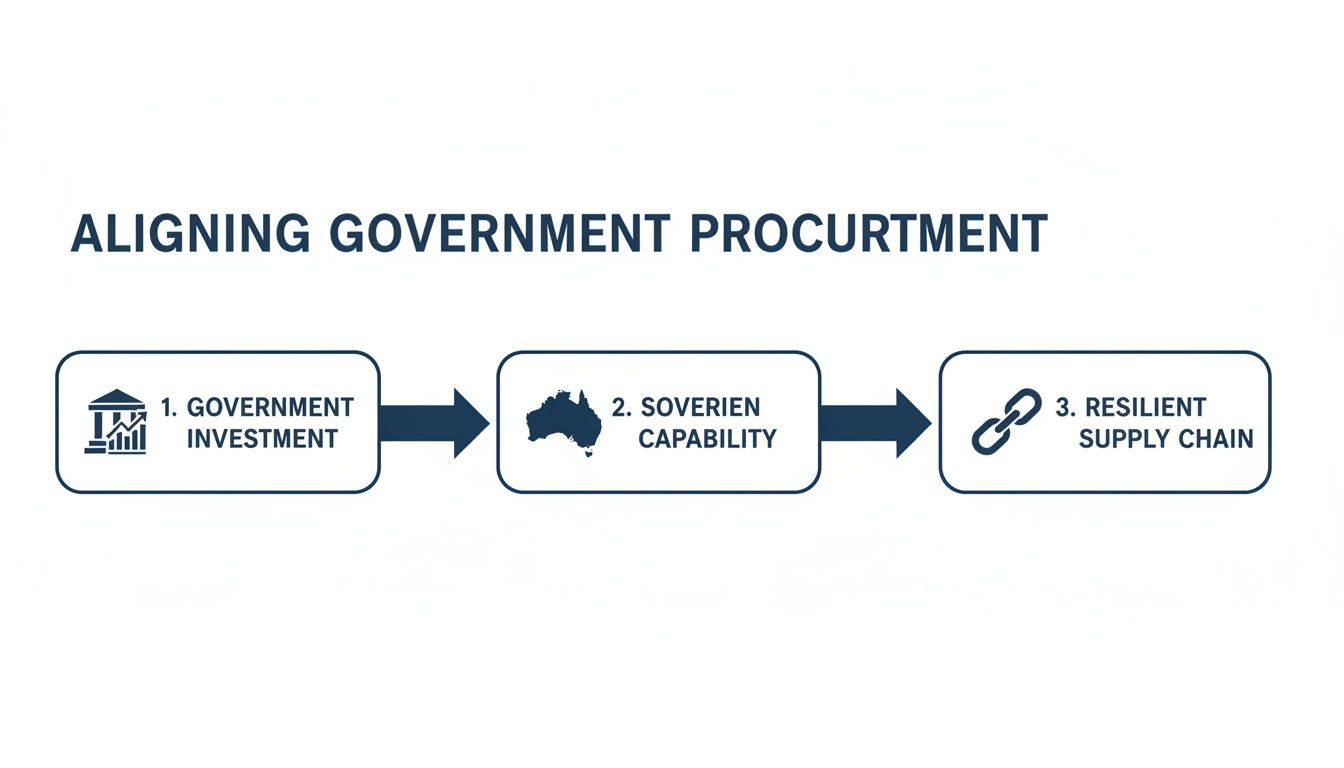
As this process illustrates, a resilient supply chain does not happen by accident. It is the direct result of aligning procurement with strategic goals like sovereign capability, ensuring security is built-in from the start.
Establishing Your Monitoring Rhythm
Continuous monitoring is a discipline built on a steady cadence of due diligence activities. Your goal is to create a living security profile for each vendor, one that you constantly update with fresh data and insights. This is how you make the security promises from the procurement phase real.
A good playbook for post-procurement monitoring should include a few key activities that provide layered assurance.
- Initial Configuration Reviews: The moment a new vendor is onboarded, review their setup. Ensure security controls like multi-factor authentication and logging are configured correctly and meet your organisation’s baseline standards.
- Regular Compliance Attestation: Do not just file away a vendor’s SOC 2 report and forget it. Track the expiry dates and have an automated process to request updated attestations annually, or whenever there’s a major change in their environment.
- Threat Intelligence Monitoring: Monitor public reports of security incidents or vulnerabilities affecting your key suppliers. A data breach at one of their other clients could easily become a direct threat to your own data.
Activating Your Contractual Rights
The contract is your most powerful tool for ongoing assurance. Those “right to audit” clauses you fought so hard for during negotiations are worthless if you never use them. Proactively scheduling audits and assessments sends a clear message that security is a non-negotiable part of the partnership.
Continuous monitoring transforms vendor relationships from a transactional “set and forget” model to a dynamic partnership. It is about maintaining trust through ongoing verification, not blind faith.
Putting those rights into action requires a structured process.
- Schedule Audits Strategically: You do not need to audit every vendor every year. Prioritise your efforts based on risk. Focus on vendors that handle your most sensitive data or are critical to your operations.
- Review New Compliance Reports: When a vendor provides an updated SOC 2 or ISO 27001 certificate, your team must actually read it. Look for new exceptions, changes in scope, or qualified opinions that could signal a change in their risk profile.
- Hold Vendors Accountable to SLAs: Track vendor performance against the security Service Level Agreements (SLAs) in your contract. If they consistently miss metrics like patching timelines, you must be ready to enforce the agreed-upon remedies.
Ultimately, this ongoing vigilance is the only way to ensure your information technology procurement decisions deliver real security value over the long term. For organisations relying heavily on external security partners, it is particularly important to understand their unique operating models. You can learn more in our guide on evaluating MSSP security services.
Frequently Asked Questions
Let’s tackle some of the common, and often tricky, questions we hear from Australian IT leaders during the information technology procurement process. These are the real-world issues that arise time and again.
How Do We Securely Procure from a Startup?
Working with a startup is a different game. You cannot expect a five-person company to produce a full suite of compliance documents like ISO 27001 or SOC 2 reports, so your due diligence needs to adapt.
Instead, focus on practical evidence of good security hygiene. Ask them to show you how they handle the fundamentals: enforcing multi-factor authentication, managing patches, and applying the principle of least privilege. Can they share results from a recent penetration test? Do they have a basic incident response plan, even if it is just a simple document?
Finally, get their technical leaders in a room. For a small team, a strong security culture and genuine expertise can offer more assurance than a certificate from a much larger, faceless organisation. A willingness to be open and answer tough questions is one of the best signs you can get.
The key is proportional assurance. Your goal is not to force a startup into a corporate compliance mould. It is to confirm they have a solid security foundation and a transparent, security-first mindset.
What Is the Difference Between GRC and TPRM?
While the two are related, Governance, Risk, and Compliance (GRC) and Third-Party Risk Management (TPRM) have different roles.
GRC is your organisation’s internal, top-down strategy for managing its own regulations, risks, and corporate governance. Think of it as the entire operational rulebook for how you run your own house.
TPRM, on the other hand, is a specific discipline that looks outwards. It focuses exclusively on identifying and managing the risks that come from your vendors and suppliers. It is a critical component that sits within your wider GRC strategy. Put simply, if GRC is your entire rulebook, TPRM is the specific chapter on how you deal with external partners.
What Are the Most Critical Security Clauses for a Contract?
Your contract is your last line of defence and your ultimate enforcement tool. While many clauses are important, these three are absolutely non-negotiable for any technology or service agreement.
-
Specific Breach Notification Timelines: Do not accept vague terms like “in a timely manner.” Your contract must mandate notification of a suspected or confirmed data breach affecting your data within a strict timeframe, such as 24 hours.
-
Right to Audit: You must explicitly reserve the right to audit the vendor’s security controls, either with your own team or a trusted third party. This clause should also compel them to provide their latest attestations (like SOC 2 reports) on at least an annual basis.
-
Data Residency and Handling: The contract must state exactly where your data can be stored, processed, and accessed from. This is essential for aligning with Australian privacy laws and any industry-specific regulations you need to meet.
Navigating the complexities of secure information technology procurement is a critical function of modern risk management. CyberPulse delivers expert Governance, Risk, and Compliance services to help Australian organisations build secure, compliant, and resilient vendor ecosystems. Learn how we strengthen your supply chain.
Browse to Read Our Most Recent Articles & Blogs
Subscribe for Early Access to Our Latest Articles & Resources
Connect with us on Social Media