Think of a Security Operations Centre (SOC) as the nerve centre of your entire cybersecurity...
Finding Business Continuity Planning Consultants in Australia
First Published:
March 12, 2026
Content Written For:
Small & Medium Businesses
Large Organisations & Infrastructure
Government
Read Similar Articles
What is the NIST Cybersecurity Framework: A breakdown for Australian Organisations
So, what is the NIST Cybersecurity Framework? In simple terms, it is a voluntary set of guidelines...
CIO’s guide to Responding to an Incident in Australia
When your organisation is hit with a cyber security incident, your response must be fast,...
Your Guide to Building a Resilient Cyber Security Strategy
A modern cyber security strategy is not a document you write once and file away. It is a living...
A Strategic Guide to NIST CSF 2.0 for Australian Leaders
Released in early 2024, NIST CSF 2.0 represents the latest evolution of a globally recognised...
Engaging business continuity planning consultants is no longer a 'nice-to-have' for Australian organisations; it is a strategic imperative for survival. These specialists provide an objective, expert view of your operational resilience, identifying vulnerabilities your internal teams are often too close to see. Furthermore, they build practical, workable plans that ensure your organisation can handle disruptions and maintain critical functions.
The Widening Gap Between Risk and Readiness
Before deciding to bring in outside assistance, it is worth running a quick internal check. This is not about a full-blown audit; instead, it involves asking honest questions to see where your blind spots might be.
The table below outlines key questions to put to your leadership team. The answers often reveal whether you possess the internal capability to build a robust BCP or if external expertise is the more sensible path.
Internal BCP Readiness Checklist
| Assessment Area | Questions for Your Leadership Team | Why This Indicates a Need for a Consultant |
|---|---|---|
| Expertise & Bandwidth | Do we have dedicated staff with recent, hands-on BCP experience? Can they commit the 100-200 hours needed for a full BIA and plan development without dropping their day jobs? | BCP is a specialised discipline. If your team is already stretched thin or lacks specific training, a consultant provides the necessary focus and expertise without disrupting operations. |
| Objectivity | Can our internal team objectively challenge long-standing assumptions about critical processes and dependencies, even if it involves senior leaders? | Internal politics and departmental silos often prevent a truly honest assessment. An external consultant brings an unbiased perspective, free from internal pressures. |
| Scenario Testing | When did we last run a realistic, challenging tabletop exercise that was not just a simple walkthrough? Did it produce actionable improvements? | Many internal tests are designed to pass. Consultants design scenarios to find breaking points, which is where the real learning happens. |
| Cross-Functional View | Have we successfully mapped dependencies across IT, Operations, HR, Legal, and our key suppliers? Is the map current and validated? | A common failure point is a BCP built in an IT silo. Consultants are experienced in facilitating cross-departmental workshops to build a truly integrated plan. |
If your team struggles to answer these questions with confidence, it is a strong indication that engaging a specialist is a necessary investment, not just an option. It shifts the burden from your team to an expert who has performed this function many times before.
Why Business Continuity Is No Longer a Choice
For Australian CIOs and CISOs, the risk landscape has changed completely. The old, clean line between disaster recovery (DR) and business continuity planning (BCP) has disappeared. A classic IT-focused DR plan is nowhere near sufficient to handle the complex, tangled threats we now face.
We are dealing with a perfect storm of sophisticated cyber attacks running alongside an undeniable increase in severe weather events and supply chain disruptions. This new reality demands a far more holistic view of operational resilience.
An objective, external perspective is crucial. Internal teams are often too close to daily operations, creating blind spots that only an independent assessment can uncover.
Engaging business continuity planning consultants provides the unbiased, analyst-grade scrutiny needed to reveal these hidden dependencies before a crisis does.
The statistics paint a sobering picture. In Australia, a staggering 50% of businesses face at least one major disruption every single year. Despite this, our research shows only 30% have a robust business continuity plan in place. Consequently, this leaves a massive gap between known risks and actual preparedness, exposing most firms to catastrophic financial and reputational losses.
Moving Beyond a Simple Tick-Box Exercise
Too many organisations fall into the trap of treating BCP as a compliance checkbox. They have a plan written, file it away on a server, and tick the box. This approach does not just fall short; it creates a dangerous illusion of security.
A truly effective BCP is a living programme, not a static document. It must be woven into the fabric of your organisation.
This requires:
- A deep risk assessment that looks at threats specific to your operations, location, and industry—from supplier failures to regulatory changes.
- True cross-departmental coordination to ensure plans are not developed in silos but are integrated across IT, operations, HR, and communications.
- Realistic scenario testing, moving beyond simple walkthroughs to conduct simulations that genuinely stress-test your response capabilities.
Internal BCP projects often fail because they lack the rigour to address these points properly. For a deeper look at the core components, our guide on what is business continuity planning is a good starting point. Without specialist guidance, plans often miss critical dependencies or fail to align with the company’s actual commercial goals.
Bringing in expert business continuity planning consultants changes the goal from merely having a plan to building genuine, verifiable resilience. It is an investment in your organisation’s long-term survival and stability in an increasingly unpredictable world.
When to Engage a Business Continuity Consultant
Deciding when to bring in external business continuity expertise is a strategic call, not a sign of failure. While the instinct is often to handle planning in-house, some situations carry risks that far outweigh the cost of a specialist.
For many Australian CIOs and CISOs, these triggers often involve major organisational change or mounting pressure from auditors and regulators. It is a mark of mature risk management to acknowledge when an impartial, expert view is needed to turn a theoretical plan into a practical one.
Internal teams, no matter how capable, often carry inherent biases. They can be too close to daily operations to spot the cascading failure points that an external consultant is trained to find.
Specific Triggers for Australian Leaders
Waiting for a disruption to reveal the gaps in your plan is a gamble you cannot afford to take. Proactive leaders watch for specific events that naturally increase risk, creating the perfect window to engage a consultant.
These are not just vague feelings of being unprepared; they are concrete business scenarios.
You should seriously consider bringing in a consultant when:
- Preparing for Audits: If your organisation faces an ISO 27001 certification audit or scrutiny under APRA’s CPS 230, an external expert can pressure-test your BCP. They know exactly what auditors look for and will find non-compliance issues before they become official findings.
- Major IT Overhauls: Migrating to a new cloud environment, rolling out a new ERP, or overhauling core infrastructure changes your operational DNA. A consultant can run a fresh Business Impact Analysis (BIA) to ensure your continuity plans align with the new tech stack.
- Mergers and Acquisitions: Integrating two organisations creates enormous complexity across processes, systems, and culture. A consultant provides a neutral third-party view to harmonise different continuity plans and pinpoint risks hidden in the integration process.
- Recent Incidents or Near Misses: If you have just weathered a security incident or a supply chain disruption, it is the ideal time for an expert-led post-incident review. Did your team feel like they ‘just scraped by’? That is a clear signal your existing plans lack robustness. For guidance on structuring your response, explore our resources on responding to an incident.
The Value of an Unbiased, Rigorous Analysis
Internal teams often work with unspoken assumptions about how things get done. A consultant’s job is to challenge those assumptions with objective, data-driven analysis.
They are paid to ask the difficult “what if” questions that internal staff might hesitate to raise for fear of rocking the boat.
An expert consultant’s primary value lies in their impartiality. They can dissect departmental silos and internal politics to map out true critical dependencies, unearthing single points of failure that insiders have long accepted as ‘just the way things are done’.
This rigorous analysis is especially vital in the unique Australian context. Modelling the downstream effects of a week-long flood in Queensland on a Melbourne-based data centre’s logistics is not a standard IT drill. It requires specialised risk assessment.
The same goes for mapping supply chain vulnerabilities stemming from regional bushfires. This demands a level of focus that goes beyond standard disaster recovery plans.
Building the Business Case for External Help
Engaging business continuity planning consultants requires a budget, and that means building a compelling business case. This is where a consultant’s expertise becomes instrumental.
They help you translate technical vulnerabilities into the clear commercial risks that get a board’s attention.
Instead of asking for a budget for “better plans,” a consultant helps you build a case based on specific, quantifiable risks. For instance, they can help you articulate that a failure in a key logistics provider could halt 70% of product deliveries, costing the business an estimated $250,000 per day.
This kind of commercially grounded data transforms the conversation. It is no longer an IT cost centre request but a strategic discussion about protecting revenue and market standing.
How to Select the Right BCP Consulting Partner
Choosing the right partner involves more than just ticking boxes on certifications. It is about finding an expert who genuinely understands the unique Australian business and threat context. A generic, off-the-shelf business continuity plan is a recipe for failure when a real disruption hits.
You need a partner whose expertise is commercially grounded and directly applicable to your operational reality. They should act as a strategic advisor, not just a temporary contractor, helping integrate the BCP into your organisation’s culture and aligning it with your risk appetite.
Vetting for Australian-Specific Expertise
The Australian regulatory and physical environment presents challenges that many international or generalist consultants simply do not grasp. You need to vet potential partners for their direct, hands-on experience with the local landscape. Do not be afraid to ask pointed questions.
A consultant worth their salt must demonstrate practical experience with:
- Local Regulatory Frameworks: Deep, working knowledge of the Australian Privacy Act and the Notifiable Data Breaches scheme is a must. For financial services, experience with APRA standards like CPS 230 (Operational Risk Management) is non-negotiable.
- Cybersecurity Standards: They must be fluent in the ASD Essential Eight Maturity Model. This is a foundational cybersecurity framework in Australia, and your BCP is incomplete if it does not align with its principles.
- Regional Threat Modelling: Ask how they model uniquely Australian risks. This is not just theoretical; it is about understanding the impact of floods in Brisbane on supply chains or how bushfires affect regional infrastructure.
A consultant’s value is directly tied to their ability to translate these local risks into a tangible, actionable plan. If they cannot speak confidently about APRA or the Essential Eight, they are not the right fit for an Australian organisation.
Cybersecurity now ranks as the number one threat to business continuity in Australia for 2026, with ransomware and phishing incidents surging 30% year-over-year. Despite this, fewer than one-third of businesses engage specialist consultants to fortify their plans, creating a significant vulnerability gap.
Comparing BCP Consultant Engagement Models
Not all engagements with business continuity planning consultants are structured the same way. Understanding the different models helps you select an approach that aligns with your budget, internal resources, and long-term goals. The wider market for consulting services offers various forms of expertise, and knowing where BCP fits can clarify your choice.
Here is a breakdown of the most common engagement models to help you find the right fit.
Comparing BCP Consultant Engagement Models
| Engagement Model | Best Suited For | Typical Commercial Structure | Common Outcomes |
|---|---|---|---|
| Project-Based | Organisations needing a specific deliverable, like a Business Impact Analysis (BIA) or a full BCP from scratch. | Fixed-price or time-and-materials. | A complete BIA report, risk assessment findings, and a documented Business Continuity Plan. |
| Managed Resilience | Firms seeking an ongoing partnership for continuous improvement, testing, and training. | Monthly or quarterly retainer. | Regular plan updates, scheduled tabletop exercises, staff training, and ongoing advisory. |
| Advisory Retainer | Companies with a mature internal BCP team that need access to senior expertise for strategic guidance or validation. | Fixed monthly fee for a set number of hours. | Expert review of existing plans, board-level reporting support, and on-call crisis advice. |
Each model serves a different purpose. A project-based engagement gets you a defined outcome, while a retainer fosters an ongoing partnership that builds resilience over time. Therefore, choose the one that best reflects your organisation’s maturity and strategic objectives.
Sharp Questions to Ask Potential Partners
Once you have a shortlist, the interview stage is your chance to cut through the sales pitch. The quality of a consultant’s answers to tough, practical questions reveals their true depth of experience. A key area to probe is their risk assessment methodology; you can learn more about what to look for in our guide on how to conduct a risk assessment.
Go beyond “Tell me about your experience.” Instead, ask targeted questions like these:
- On Risk Assessment: “Walk me through your methodology for identifying single points of failure that are not purely IT-related. Can you give me an anonymised example from a client in our industry?”
- On Plan Testing: “Describe the most challenging tabletop exercise you have facilitated. What made it challenging, and what were the key lessons the client learned?”
- On Commercial Grounding: “How do you ensure the final BCP is a practical, usable document for our operational teams, not just a theoretical plan that sits on a shelf?”
- On Regulatory Alignment: “How have you helped a client align their BCP with APRA’s CPS 230 requirements, specifically concerning tolerance levels for critical operations?”
Their responses will tell you everything you need to know about their ability to deliver a commercially focused, actionable, and resilient BCP. Pay attention not just to what they say, but how they say it. Confidence born from experience is hard to fake.
Getting the Most Out of Your BCP Consultant Engagement
Hiring business continuity planning consultants is a significant investment. However, the real return hinges on how you manage the engagement itself. Simply handing over the keys and waiting for a plan to appear is a surefire way to get a document that just gathers dust.
Real value comes from a genuine partnership. This means active, hands-on involvement from your team, right from the first kickoff meeting through to the final plan handover. When you are an active participant, you get more than a compliance checkbox; you get a practical, living framework that actually fits how your organisation works.
The process of picking the right consultant lays the groundwork for this partnership. It is about moving from a wide-angle view to a focused one before you commit.
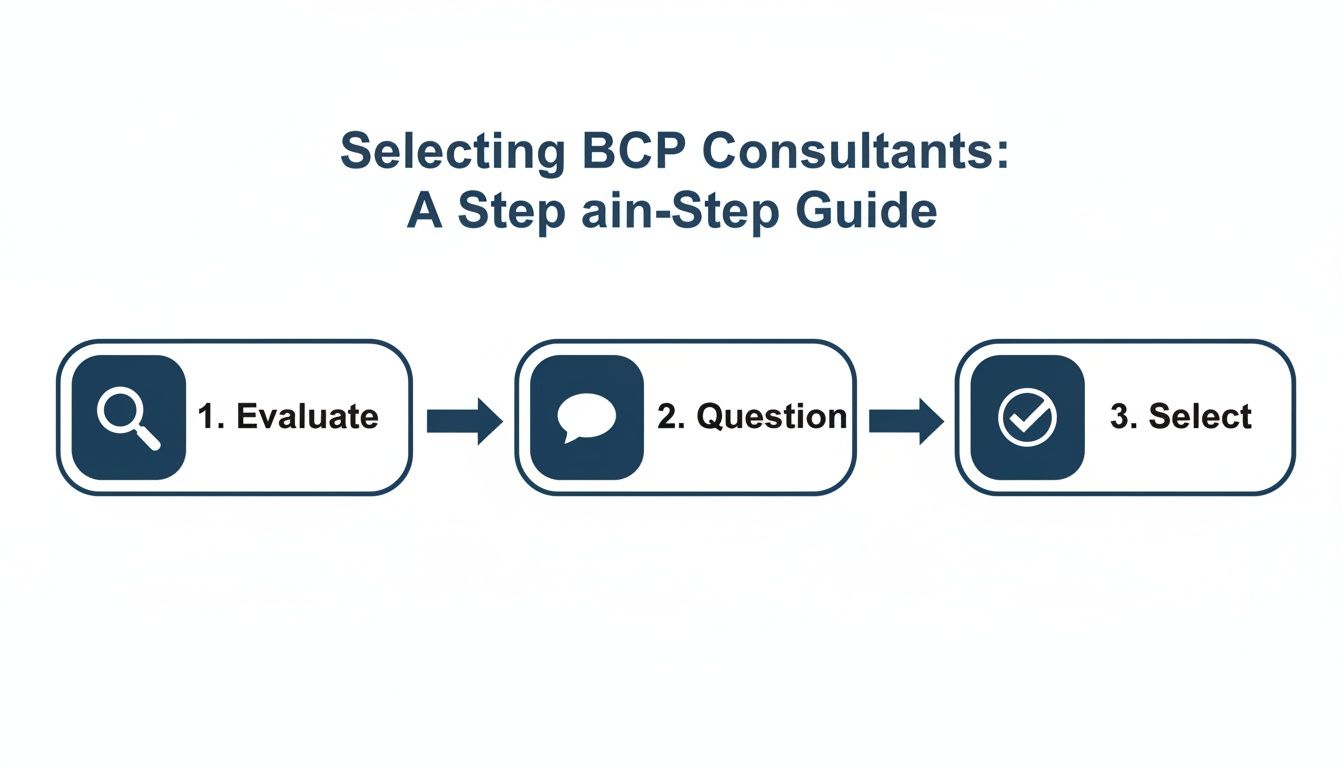
This evaluation process is not just about vetting suppliers. It is the first step in building a successful collaboration that will deliver real resilience.
Mapping the Project Journey
Knowing what a typical BCP consulting project looks like helps you set realistic expectations for your own team’s time and effort. While no two projects are identical, they generally follow a predictable path. Your active involvement at each stage is what makes the difference.
Most engagements move through these stages:
- Kickoff and Scope Lock-in: This first meeting is crucial. It is where you and the consultant agree on the exact scope, timelines, key contacts, and how you will communicate.
- Discovery and Analysis: The consultants will need to talk to your people and see your documentation. This is where they will conduct Business Impact Analysis (BIA) interviews and risk workshops to find your pressure points.
- Strategy and Plan Drafting: Using what they have learned, the consultant will build out recovery strategies and write the first draft of your Business Continuity Plan (BCP). This should be an iterative process where your feedback is essential.
- Review and Reality Check: Your team gets to review the draft plan. This is your chance to make sure it is accurate, workable, and truly meets your needs. Do not be afraid to challenge assumptions.
- Handover and Training: The consultant delivers the final documents, often with a presentation for senior leadership and training for the teams responsible for using the plan.
Getting Your Internal Team Ready
A BCP is only as good as the information that goes into it. A consultant cannot build a realistic plan in a vacuum. Preparing your internal teams is one of the most critical things you can do to ensure success.
One of the most common mistakes we see is appointing stakeholders who do not have the authority or deep operational knowledge to give accurate answers. Make sure your contacts are the genuine subject matter experts for their business units.
To keep things running smoothly, you should:
- Appoint a project lead: Designate one person from your organisation to be the main point of contact. This prevents crossed wires and keeps information flowing cleanly.
- Brief your stakeholders: Let department heads and key experts know they will be needed for interviews and workshops. Explain why their input is so important for the project’s outcome.
- Pull documents together early: Get a head start by gathering documents the consultant will need, like current IT DR plans, org charts, network diagrams, and key supplier contracts.
Doing this prep work upfront frees up the consultant to focus on high-value strategy and analysis, rather than chasing down paperwork. That efficiency translates directly into a better return on your investment.
Your Essential Deliverable Checklist
Knowing what to expect as a final output is key. While the specifics will be unique to your organisation, a proper engagement with business continuity planning consultants should always produce a core set of deliverables. These documents are the foundation of your resilience program.
It is also worth thinking about how your BCP interacts with other risk controls, like your insurance cover. Our detailed guide on cyber insurance in Australia can help you understand those connections.
At a minimum, your final package should include:
- A Business Impact Analysis (BIA) Report: This report identifies your most critical business functions, their dependencies, and defines your Recovery Time Objectives (RTOs) and Recovery Point Objectives (RPOs).
- A Detailed Risk Assessment: This document pinpoints the specific threats your organisation faces—from cyber attacks and supply chain failures to natural disasters—and scores their likelihood and potential impact.
- The Business Continuity Plan (BCP): This is the main event. It is a practical, step-by-step guide for responding to, recovering from, and restoring your critical functions after a disruption.
- An Executive Summary Presentation: This is a high-level overview for your board and senior leaders. It translates the BCP’s technical details into a clear statement on commercial risk and resilience strategy.
By actively managing the engagement and ensuring these deliverables land, you turn a simple purchase into a strategic investment in your organisation’s future.
Bringing Your New Business Continuity Plan to Life

Having a completed business continuity plan in hand is a huge milestone, but it is really just the beginning. A plan that gathers dust on a shelf is worthless. A plan that is tested, validated, and embedded in your culture, on the other hand, is priceless. The real work starts now, shifting from documentation to active, demonstrable resilience.
This is where your partnership with business continuity planning consultants really pays off. Their role changes from planner to facilitator and validator. They guide you through the critical process of testing, integrating the plan into daily operations, and establishing a cycle of continuous improvement. This is how you turn a static document into a living program that genuinely protects your organisation.
From Theory to Practice: BCP Testing Methods
Exercising your plan is not about passing or failing. Think of every exercise as a learning opportunity—a chance to find weaknesses in a controlled environment, long before a real crisis hits. Your consultant’s job is to help design scenarios that are realistic, challenging, and directly tied to the risks you identified in your BIA.
The goal here is to stress-test your response capabilities, not just tick a box. Different methods offer different levels of intensity, each with its own resource commitment.
Common BCP testing methods include:
- Desktop Walkthroughs: The simplest form of testing. Key team members gather to review the plan document together. It is an excellent way to spot inconsistencies, outdated contact lists, or logical gaps in your procedures.
- Tabletop Exercises: This is the most common format, and for good reason. Your consultant facilitates a discussion-based session, walking your crisis management team through a realistic, unfolding scenario—like a ransomware attack or a critical supplier going offline. It effectively tests decision-making, communication protocols, and team dynamics without disrupting normal business.
- Full-Scale Simulations: As the most intense and resource-heavy option, these exercises involve physically acting out parts of your plan. This could mean relocating staff to a recovery site or failing over critical IT systems to a secondary location. While disruptive, they offer the most accurate measure of your true recovery capabilities.
The real value of regular exercising is building ‘muscle memory’ in your teams. When people have practised their roles under simulated pressure, their response during a genuine incident becomes faster, more confident, and far more effective.
Integrating BCP With Core Business Functions
A business continuity plan cannot operate in a vacuum. For it to work, it has to be deeply integrated with your organisation’s core operational and security functions. Your consultant will help you weave the BCP into the fabric of your daily operations, ensuring it is not forgotten until it is too late.
Nowhere is this integration more critical than with cybersecurity. An effective plan must align with your incident response (IR) procedures and broader security frameworks. For example, your BCP should specify exactly what triggers the activation of the cyber IR team and define how communication will be managed during a data breach. A robust plan also directly supports compliance with standards like ISO 27001, which explicitly requires business continuity management.
To truly bring your new plan to life, understanding the actual essential business continuity planning steps is paramount. This knowledge helps ensure every part of your plan, from initial analysis to ongoing maintenance, is built on a solid foundation.
The Non-Negotiable Need for Regular Reviews
The threat landscape is not static, and neither is your business. New risks emerge, technology evolves, and key people change roles. A plan written just last year might already have critical gaps. That is why regular reviews and updates are non-negotiable for maintaining genuine resilience.
Your consultant should help you set up a formal review cycle. As a baseline, you should review and update your BCP annually, or whenever a significant change occurs, such as:
- An office relocation or major infrastructure change.
- A merger, acquisition, or significant restructuring.
- The launch of a new critical system or service.
- After any real incident or even a close call.
This ongoing cycle of testing, integrating, and reviewing ensures your organisation is not just prepared for yesterday’s threats, but is ready to face tomorrow’s challenges with confidence. You can also explore our article on business continuity plan examples to see how these concepts are applied in practice.
Answering Your BCP Consultant Questions
When you are considering bringing in external help, a few key questions always come up. To give you the final pieces of the puzzle, we have gathered the most common questions Australian IT and risk leaders ask about engaging business continuity planning consultants.
Think of this as the conversation you would have with an expert over coffee—clear, direct answers to help you move forward with confidence.
What Is the Difference Between a BCP and a DR Plan?
This is one of the most critical distinctions, and it is a source of much confusion. The simplest way to think about it is that Disaster Recovery (DR) is a focused, technical subset of a much broader Business Continuity Plan (BCP).
A DR plan is all about getting your IT back online. It deals with restoring servers, applications, and data after a technical outage. It is the playbook for your tech team.
A BCP, on the other hand, looks at the entire organisation. It answers the bigger question: “How do we keep the business running when things go wrong?” This includes your people, your critical processes, your suppliers, and how you communicate with customers—not just the technology that supports them. A DR plan gets the servers running again, but the BCP ensures your call centre team has a place to work from and a script to use.
What Should I Expect During a Business Impact Analysis?
The Business Impact Analysis (BIA) is the bedrock of any good business continuity plan. It is an intensive discovery process where the consultant digs deep to identify and quantify what a disruption would actually cost your business, both financially and operationally.
Do not expect this to be a passive exercise. Your team’s involvement is crucial. During the BIA, your consultant will:
- Conduct detailed interviews with your department heads and the people who actually do the work.
- Map out critical business processes and uncover all their dependencies—the tech, the staff, and the third parties they rely on.
- Define Recovery Time Objectives (RTOs), which is the maximum time a business function can be down before the impact becomes unacceptable.
- Establish Recovery Point Objectives (RPOs), which determines the maximum amount of data you can afford to lose.
The quality of the BIA directly dictates the quality of your final plan. It needs real data and honest input from your team to be effective.
How Much Does a BCP Consultant Engagement Typically Cost in Australia?
Costs can vary quite a bit depending on the size and complexity of your organisation, but having some ballpark figures is useful for initial budgeting.
- For a Small to Medium-Sized Enterprise (SME): A project to develop a BIA and a complete BCP usually falls between $20,000 and $45,000.
- For a Larger Enterprise: If you have multiple business units and complex interdependencies, you can expect costs to range from $50,000 to over $150,000.
- Ongoing Managed Services: For a retainer model that includes regular testing, plan updates, and advisory, you are typically looking at $3,000 to $10,000 per month.
It is important to frame this cost as an investment in resilience. When you stack it up against the potential cost of a major disruption—which can easily hit hundreds of thousands of dollars per day in lost revenue and reputational damage—the business case becomes incredibly clear.
How Long Does a Typical BCP Project Take?
Like the cost, the timeline depends heavily on scope and how available your own people are. A consultant can set a fast pace, but the project ultimately moves at the speed your organisation can provide information, review drafts, and make decisions.
Here is a rough guide for a standard project:
- Kickoff and Scoping: 1–2 weeks
- Business Impact Analysis (BIA) and Risk Assessment: 4–6 weeks
- Strategy Development and Plan Drafting: 3–5 weeks
- Review, Finalisation, and Handover: 2–3 weeks
All up, a typical end-to-end BCP project for a mid-sized organisation usually takes between 10 to 16 weeks. It is certainly possible to do it faster, but that requires a highly engaged and responsive team on your end.
Building a resilient organisation is about more than just writing a document; it is about creating a true capability. That requires a partnership with experts who understand the Australian threat landscape and what it takes to keep a business running. At CyberPulse, our specialists deliver commercially-grounded business continuity planning to ensure your organisation is ready for whatever comes next. Contact CyberPulse today to build a robust and actionable resilience program.
Browse to Read Our Most Recent Articles & Blogs
Subscribe for Early Access to Our Latest Articles & Resources
Connect with us on Social Media