Think of a Security Operations Centre (SOC) as the nerve centre of your entire cybersecurity...
What is the NIST Cybersecurity Framework: A breakdown for Australian Organisations
First Published:
March 9, 2026
Content Written For:
Small & Medium Businesses
Large Organisations & Infrastructure
Government
Read Similar Articles
Finding Business Continuity Planning Consultants in Australia
Engaging business continuity planning consultants is no longer a 'nice-to-have' for...
CIO’s guide to Responding to an Incident in Australia
When your organisation is hit with a cyber security incident, your response must be fast,...
Your Guide to Building a Resilient Cyber Security Strategy
A modern cyber security strategy is not a document you write once and file away. It is a living...
A Strategic Guide to NIST CSF 2.0 for Australian Leaders
Released in early 2024, NIST CSF 2.0 represents the latest evolution of a globally recognised...
So, what is the NIST Cybersecurity Framework? In simple terms, it is a voluntary set of guidelines and best practices that helps organisations manage and reduce their cybersecurity risks. It is not a rigid checklist, but rather a flexible blueprint for building a more secure and resilient business.
A Strategic Blueprint for Australian Cyber Resilience

Many Australian boards grapple with the same challenge: how do you translate complex cyber risks into an actionable business strategy? The NIST CSF provides a common language to bridge that gap. Consequently, it unifies everyone, from the executive team down to the IT department, around a shared goal.
This is how security moves from a technical silo into a core business function. To understand where the CSF fits, it helps to see it as part of a wider ecosystem.
The Evolution to CSF 2.0
The framework was first developed for U.S. critical infrastructure, but its practical value led to widespread global adoption. The latest version, CSF 2.0, marks a major evolution. Released for the framework’s 10th anniversary, it introduces the crucial Govern function, placing a new emphasis on executive buy-in and strategic oversight.
To give you a quick overview, the framework now revolves around six core functions.
The NIST Cybersecurity Framework 2.0 at a Glance
| Core Function | Purpose |
|---|---|
| Govern | Establish and monitor the organisation’s cybersecurity risk management strategy, expectations, and policy. |
| Identify | Understand cybersecurity risks to systems, assets, data, and capabilities. |
| Protect | Implement appropriate safeguards to ensure the delivery of critical services. |
| Detect | Implement activities to identify the occurrence of a cybersecurity event. |
| Respond | Take appropriate action after a detected cybersecurity incident. |
| Recover | Plan for resilience and restore any capabilities or services that were impaired due to an incident. |
The addition of the Govern function is a game-changer. It formalises what many of us have known for years: cybersecurity is not just an IT problem. It is a fundamental part of corporate strategy and risk management that demands a seat at the executive table.
This shift reflects a maturing global view on cyber risk. Today, an estimated 84% of organisations worldwide use frameworks like NIST. Australian adoption is not far behind, with around 70% in regulated industries using a formal framework.
The new Govern function is just one of the key updates in CSF 2.0. We explore these changes and what they mean for Australian businesses in our detailed guide on what NIST CSF 2.0 means for your organisation. Ultimately, the framework offers a structured way for Australian leaders to not only defend against threats but also build a provably secure and trusted organisation.
Why the NIST CSF Is a Commercial Imperative for Australian Businesses
For many Australian business leaders, adopting a cybersecurity framework feels like a purely technical compliance task. However, seeing the NIST CSF only through that lens means missing its real value. It is a commercial strategy for building a resilient, competitive, and trusted organisation.
Adopting the framework is not a cost centre; it is a strategic investment. It directly tackles two of the biggest commercial headaches for Australian organisations today: the critical cybersecurity skills shortage and the crippling financial penalties that come with data breaches. The framework gives your teams a clear, structured roadmap, turning security from a reactive chore into a genuine business enabler.
Bridging the Critical Skills Gap
The Australian market grapples with a severe shortage of cybersecurity talent. This deficit creates huge operational risks, leaving organisations exposed as they scramble to fill vital security roles. The NIST CSF provides a practical way forward by standardising your security program.
Instead of relying on the intuition of a few overworked experts, the framework establishes clear processes and controls that anyone on your team can manage and scale. This empowers less-specialised IT staff to make a real contribution to your security posture. Furthermore, it creates a common language and defines responsibilities, meaning your teams operate more efficiently, even when stretched thin. You can explore how to build a robust defence in our guide to developing a powerful cyber security strategy.
Enhancing Incident Response and Reducing Breach Impact
With cyber attacks on the rise, how fast and effectively you respond to an incident can be the difference between a minor hiccup and a commercial catastrophe. This is where the NIST CSF really proves its worth.
The framework’s Respond and Recover functions give you a battle-tested plan for when an incident strikes. By having these processes defined, documented, and rehearsed before a breach happens, your organisation can act with precision and speed. The data backs this up. Australia faces a projected shortage of 18,000 cybersecurity professionals by 2026, yet Australian companies using NIST report up to 30% faster incident response times. This capability helps them shift from reactive defence to proactive strategy, especially as ransomware attacks, which affected 62% of Aussie organisations in 2023, continue to climb.
This capability directly reduces financial damage and reputational harm, particularly under Australia’s Notifiable Data Breaches (NDB) scheme, where penalties can be severe.
For any CISO or risk leader, the NIST CSF is a powerful tool for boardroom conversations. It translates technical security metrics into the language of commercial risk, helping you articulate the value of security in terms of financial impact, operational resilience, and brand trust.
Building Competitive Advantage and Stakeholder Trust
Ultimately, your organisation’s security posture is a direct reflection of its reliability. In a market where customers, partners, and regulators are all scrutinising security practices, a demonstrated commitment to a standard like the NIST CSF builds enormous trust.
Implementing the framework signals to the market that you are serious about protecting data and managing risk. This builds confidence among stakeholders and quickly becomes a significant competitive differentiator. By showing you follow a globally respected answer to what is the NIST Cybersecurity Framework, you are not just ticking a compliance box; you are building a more resilient and commercially successful business.
Breaking Down the NIST CSF: The Core Functions and Implementation Tiers
To get real value from the NIST Cybersecurity Framework, you need to look past the high-level summary and get into its practical mechanics. The Framework’s true power comes from its logical structure, which is built around six Core Functions and four Implementation Tiers.
Think of the Functions as the what—the essential cybersecurity activities you need to perform—and the Tiers as the how well—the maturity and sophistication of how you perform them. For Australian IT managers and compliance leaders, understanding these two components is the key to running effective self-assessments and building a lasting security program.
The Six Core Functions: A Complete Cybersecurity Lifecycle
The NIST CSF 2.0 is anchored by six foundational pillars, known as Functions. Together, they map out the complete lifecycle of managing cybersecurity risk, from high-level strategy all the way through to incident recovery. They give security teams a common language and a clear way to organise their defence activities.
Here’s how each Function works in the real world for an Australian organisation:
- Govern: This is a new and critical addition in CSF 2.0. It makes cybersecurity an enterprise-wide risk management issue, not just an IT problem. It involves setting the security strategy, defining roles, and making sure cyber objectives directly support business goals. For an Australian financial services firm, this means the board is actively involved in signing off on the cyber risk appetite, not just leaving it to the CISO.
- Identify: You cannot protect what you do not know you have. This Function is all about developing an organisational understanding of the cyber risks to your systems, people, assets, and data. In a typical hybrid cloud environment, this means keeping a live inventory of every on-premises server, cloud instance, and SaaS app that handles customer information.
- Protect: This is where you implement the right safeguards to keep critical services running. It includes technical controls like firewalls and endpoint protection, but it also covers physical security and security awareness training for staff. For a healthcare provider in Australia, this would mean encrypting patient records both when they are stored (at rest) and when they are being sent (in transit).
- Detect: An organisation has to be able to spot a cybersecurity event quickly. This Function covers the continuous monitoring of networks, logs, and endpoints to identify unusual activity. For instance, an Australian retailer would use Security Information and Event Management (SIEM) tools to flag an alert if a large number of files are accessed outside of business hours.
- Respond: When an incident is detected, you need a clear plan. This Function covers all the activities required to take action, including response planning, communications, analysis, and containment. During a ransomware attack, this is what guides an organisation to isolate affected systems, bring in incident response specialists, and communicate with stakeholders according to a pre-approved plan.
- Recover: The final Function is about getting back to normal operations quickly to reduce the impact of an incident. It involves creating and testing plans for resilience and restoring any capabilities or services that were impaired. After a major outage, this would guide a law firm in restoring its core practice management system from secure, off-site backups.
Adopting these Functions helps build a well-rounded program that improves skills, speeds up response times, and strengthens trust with customers and partners.
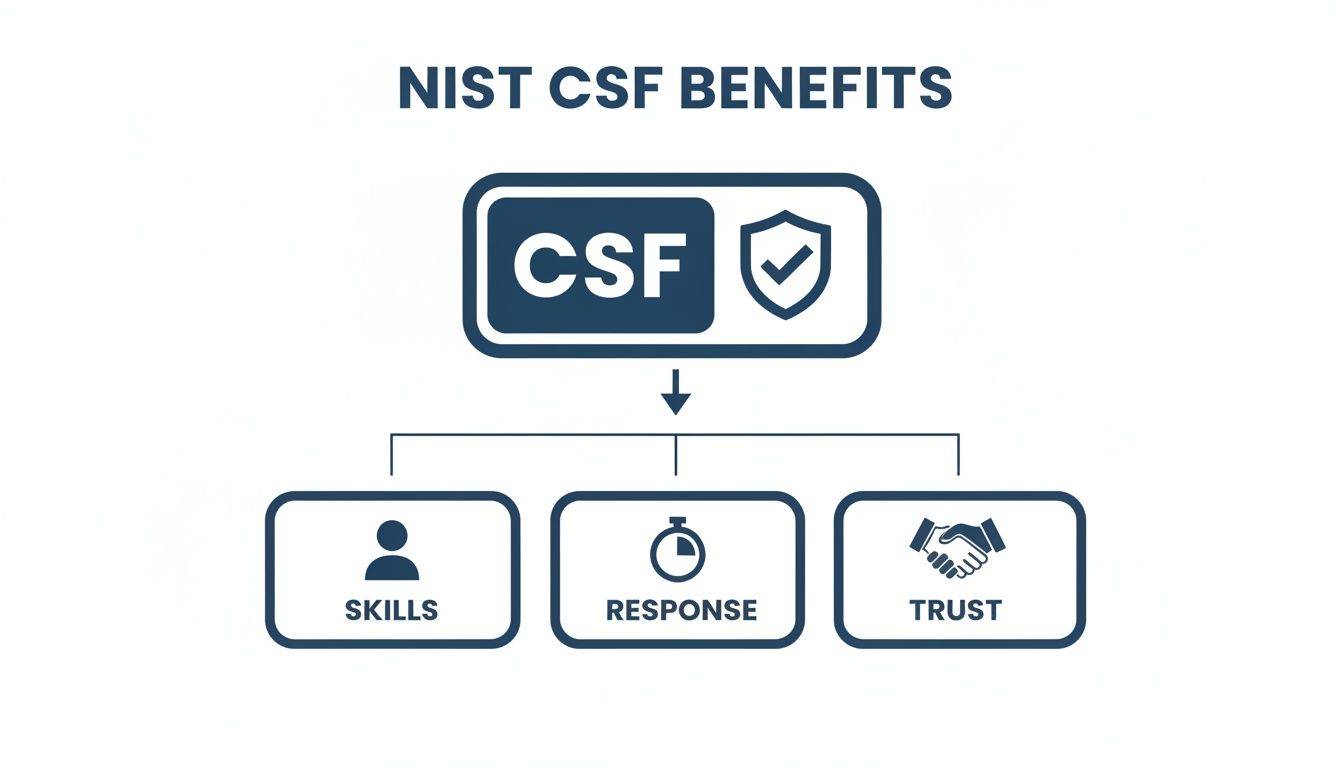
As the diagram shows, this structured approach does not just tick compliance boxes; it delivers tangible improvements in team capability, response effectiveness, and overall market confidence.
The Four Implementation Tiers
Alongside the Core Functions, the NIST CSF provides four Implementation Tiers. It is important to know that these are not traditional maturity levels. Instead, they describe the rigour and sophistication of an organisation’s cybersecurity risk management practices. They offer a practical way to benchmark where you are now and set a realistic target for where you need to be.
To dig deeper into benchmarking, you might find our guide on how to conduct a comprehensive risk assessment useful. Understanding your current Tier is the first step toward making meaningful improvements.
Crucially, reaching Tier 4 is not the goal for every organisation. The appropriate Tier depends entirely on your unique business objectives, risk tolerance, and regulatory landscape. For many Australian SMEs, achieving a solid Tier 2 or Tier 3 represents a strong and defensible security posture.
Here’s a breakdown of what each Tier looks like in practice:
- Tier 1: Partial
Cybersecurity risk management is informal, ad-hoc, and usually reactive. There is little awareness of cyber risk at an organisational level, and any processes that exist are inconsistent and undocumented. - Tier 2: Risk-Informed
Management has approved risk management practices, but they may not be established as an organisation-wide policy yet. There is an awareness of cyber risk, but collaboration and information sharing are still fairly informal. - Tier 3: Repeatable
The organisation has formal, documented, and consistently applied risk management practices and policies. Senior executives are actively engaged, and the organisation has a good understanding of its dependencies on partners and suppliers. - Tier 4: Adaptive
The organisation actively adapts its cybersecurity practices based on lessons learned and predictive indicators. It shares threat information with the wider community and uses real-time data to anticipate and counter emerging cyber threats before they cause harm.
How the NIST CSF Unifies Australian Compliance Mandates
For many Australian compliance leaders, the regulatory environment feels like a tangled web of overlapping requirements. Juggling ISO 27001, the ASD Essential Eight, SOC 2, and PCI-DSS at the same time often leads to duplicated effort, wasted resources, and serious compliance fatigue.
This is precisely where the NIST Cybersecurity Framework (CSF) provides immense practical value. It does not compete with these mandates; it organises them. Think of the NIST CSF as a master key or a common language for cyber risk management. Its flexible, risk-based structure gives you a solid foundation that directly supports the specific controls in other standards, helping to bring order to your entire compliance program.
A Common Ground for ISO 27001 and the Essential Eight
The NIST CSF acts as a powerful bridge between different standards, most notably ISO 27001 and the Australian Signals Directorate’s (ASD) Essential Eight. While each has a unique focus, they share the same goal of reducing cyber risk. The CSF helps align how you get there.
-
For ISO 27001: The CSF’s risk management lifecycle—from Identify through to Recover—gives you a practical roadmap for building and maintaining an Information Security Management System (ISMS) required by ISO 27001. The functions help you systematically work out your risks and then select the right controls from ISO 27001’s Annex A, which can seriously speed up your certification journey.
-
For the ASD Essential Eight: The Essential Eight provides specific, prioritised mitigation strategies that are mandatory for Australian government agencies and highly recommended for everyone else. The NIST CSF’s Protect and Detect Functions align perfectly with these strategies, covering things like application control, patching, and restricting admin privileges. Using the CSF provides a broader risk context for implementing these crucial technical controls, making them part of a bigger picture.
Adopting the CSF means you are not starting from scratch for each new compliance demand. Instead, you are building on a consistent, well-understood foundation. Our experts often provide detailed guidance on navigating the complexities of the Australian Government Information Security Manual and how it fits with other frameworks.
Streamlining SOC 2 and PCI-DSS Compliance
The unifying power of the NIST CSF is just as effective for industry-specific and trust-based standards like SOC 2 and the Payment Card Industry Data Security Standard (PCI-DSS). The CSF’s structured approach makes it much simpler to show auditors and partners that your security is under control.
For instance, a SOC 2 audit measures an organisation against the Trust Services Criteria (Security, Availability, Processing Integrity, Confidentiality, and Privacy). The NIST CSF’s Core Functions give you a logical way to organise and present evidence for each of these. The Protect function, for example, directly supports the Security criterion by proving that you have access controls and data protection measures in place.
It is a similar story for PCI-DSS, which requires very strict controls to protect cardholder data. The NIST CSF provides the overarching risk management framework. By mapping PCI-DSS requirements back to the CSF’s Functions and Categories, you can manage them as part of your holistic cybersecurity program instead of treating them like a separate, standalone checklist.
By bringing multiple compliance efforts under the single umbrella of the NIST CSF, organisations cut down on administrative burden, stop doing redundant control assessments, and get a much better return on their compliance investment. That efficiency is critical for hitting certification timelines and staying continuously ready for an audit.
The table below shows how the CSF complements other major compliance frameworks, acting as a unifying structure that brings clarity to your efforts.
How the NIST CSF Aligns with Key Australian Frameworks
| Framework | How NIST CSF Helps | Primary Benefit |
|---|---|---|
| ISO 27001 | Provides a risk management lifecycle (Identify, Protect, etc.) to structure an ISMS and select Annex A controls. | Accelerates certification and simplifies risk assessment. |
| ASD Essential Eight | Offers a strategic context for implementing the eight mandatory technical controls within a broader risk framework. | Ensures technical controls are part of a holistic security strategy, not just a checklist. |
| SOC 2 | The Core Functions map directly to the Trust Services Criteria, making it easier to organise and present evidence. | Simplifies audit preparation and evidence management for Type 2 reports. |
| PCI-DSS | Allows security teams to manage cardholder data protection requirements as part of an integrated program, not a silo. | Reduces administrative overhead and avoids duplicated control assessments. |
Ultimately, the NIST CSF provides the “why” and “what” of your security program, allowing these other frameworks to define the specific “how” for their unique requirements.
Proven Synergies and Measurable Gains
This strategic alignment between the NIST CSF and Australian mandates delivers real, tangible results. Following the strengthening of Essential Eight requirements, organisations that used NIST’s core functions to profile their risks saw a 40% reduction in the successful exploitation of vulnerabilities.
For regulated sectors like healthcare and legal, the framework’s synergy with Australia’s Privacy Principles simplifies dual-compliance efforts, cutting security program development time by an average of 30%.
This data highlights a critical point for CISOs and risk leaders: implementing the NIST CSF is not just another compliance task. It is a strategic move that unifies your security efforts, strengthens your defences, and delivers measurable commercial and operational advantages across the board.
Your Step-by-Step Guide to Adopting the NIST Cybersecurity Framework

Understanding the theory behind the NIST Cybersecurity Framework is one thing. However, turning that theory into a practical, repeatable plan is something else entirely. Adopting the framework is not a one-off project; it is an ongoing cycle of improvement that embeds cyber resilience deep into your organisation’s DNA.
For Australian leaders, this means moving beyond asking what is the NIST Cybersecurity Framework to asking how it will protect the business and support commercial goals. This structured, six-step process offers a clear path from initial planning to continuous improvement, ensuring your adoption effort is both strategic and sustainable.
Step 1: Set Your Scope and Secure Executive Support
Before any technical work starts, you need to define your scope. Will the framework apply to the entire organisation, or will you begin with a single high-risk business unit, like the team handling sensitive customer data? You must tie this decision directly to your core business objectives.
Next, you need to get the board and C-suite on board. This means presenting the framework not as a technical cost but as a strategic investment in business resilience and growth. Therefore, frame the conversation around risk reduction and commercial advantage to secure executive buy-in.
Step 2: Create a Current State Profile
Once you have your mandate, you need to know where you stand. This involves building a Current Profile of your organisation’s cybersecurity posture. Think of it as an honest, clear-eyed assessment of where you are right now.
To get this done, you will map your existing activities, controls, and processes against the Functions, Categories, and Subcategories of the NIST CSF. This process quickly shows you what you are already doing well and, more importantly, where your gaps are.
Step 3: Run a Comprehensive Risk Assessment
With your Current Profile complete, the next step is to conduct a risk assessment. This is where you connect your cybersecurity activities to real-world business risks. You will identify potential threats to your systems and data, evaluate their likelihood and potential impact, and then prioritise them based on your organisation’s risk tolerance.
This step is critical. It ensures your security efforts focus on the threats that actually matter to your Australian operations. Effective risk management is the backbone of any strong cybersecurity program. For a deeper look at this process, you can explore our detailed guide on effective cyber security Governance, Risk, and Compliance (GRC).
Step 4: Define a Target State Profile
Now it is time to decide where you want to go. Your Target Profile is your desired cybersecurity outcome—your “to-be” state. You will build this profile based on your risk assessment, business requirements, and any compliance obligations you have.
Your Target Profile should be both aspirational and realistic. For a mid-sized Australian business, aiming for a “Tier 3: Repeatable” posture might be a perfect goal, whereas a national critical infrastructure provider might aim for “Tier 4: Adaptive”. The goal is progress, not perfection.
This Target Profile becomes the benchmark you will measure success against. It provides a clear, consensus-driven vision for your entire security program.
Step 5: Analyse Gaps and Build Your Action Plan
With both your Current and Target Profiles in hand, you can now perform a gap analysis. This is simply a comparison of the two profiles to identify the specific areas needing improvement. The result is a prioritised list of actions required to get from your current state to your target state.
Your action plan must be practical and detailed. It should outline:
- Specific actions needed to close each gap.
- Resources required, including budget, people, and technology.
- Clear timelines and measurable milestones for implementation.
This plan becomes your roadmap for the whole implementation project, making sure everyone knows their roles and responsibilities.
Step 6: Implement the Plan and Monitor Continuously
Finally, it is time to execute your action plan. This is where you put new controls in place, update processes, and deploy technologies to close the gaps you identified.
But adoption does not end when the plan is implemented. Cybersecurity is a dynamic field, and your program must be able to adapt. You need to continuously monitor your controls, review your risk assessments, and update your Profiles to reflect changes in the threat landscape and your own business. This cyclical process ensures your organisation stays resilient and audit-ready for the long term.
Frequently Asked Questions About the NIST CSF in Australia
For Australian leaders considering the NIST Cybersecurity Framework, a few common questions always come up. Here are straightforward answers to help you make informed decisions.
Is the NIST Cybersecurity Framework Mandatory in Australia?
No, the NIST CSF is not mandatory for most private sector businesses in Australia. Instead, it is widely seen as a best-practice standard for building a sound cyber risk management program.
However, for some sectors, it comes very close to being a requirement. Organisations in critical infrastructure often find NIST CSF principles embedded in their specific regulations. The Australian Energy Sector Cyber Security Framework (AESCSF), for example, is heavily influenced by it. Its strong alignment with the mandatory ASD Essential Eight also makes it a powerful way to show due diligence to regulators and partners.
How Long Does It Take to Implement the NIST CSF?
The timeline depends entirely on an organisation’s size, complexity, and current security maturity. A small business with a straightforward IT environment might reach a baseline level of maturity (like Tier 2) in 3-6 months.
A larger enterprise aiming for a more integrated program (like Tier 3) could be looking at a 12-18 month project, or even longer. It is better to think of implementation as an ongoing improvement cycle, not a one-off project. Most find a phased approach that tackles high-risk areas first is the most effective way forward. When adopting a comprehensive framework like NIST CSF, businesses often seek expert cyber security consulting to guide them through the process.
What Is the Main Difference Between NIST CSF 2.0 and the Previous Version?
The biggest change in NIST CSF 2.0 is the new ‘Govern’ function. This formally makes cybersecurity a core part of enterprise risk management and brings it into the boardroom, ensuring strategy and accountability start from the top.
The ‘Govern’ function addresses a long-standing challenge by embedding cybersecurity into corporate strategy, moving it from a technical silo to a boardroom-level priority.
Version 2.0 also officially expands the framework’s scope. It is now explicitly designed for all organisations, not just critical infrastructure. Finally, it adds better guidance on managing supply chain risks and more resources to help a wider range of businesses adopt it successfully.
CyberPulse provides expert, end-to-end guidance to help Australian organisations adopt the NIST CSF, accelerate certification, and build lasting cyber resilience. Strengthen your security posture with a proven partner. Learn more at https://www.cyberpulse.com.au.
Browse to Read Our Most Recent Articles & Blogs
Subscribe for Early Access to Our Latest Articles & Resources
Connect with us on Social Media