
SOC 2 Audit Services Australia (Type I & Type II)
SOC 2 (also written as SOC2) is a cybersecurity compliance framework developed by the American Institute of Certified Public Accountants (AICPA) for service organisations that store, process, or transmit customer data in cloud and SaaS environments. SOC 2 audits evaluate security controls against five Trust Services Criteria: security, availability, processing integrity, confidentiality, and privacy.SOC 2 reports come in two types. A Type I report assesses whether controls are suitably designed at a point in time. A Type II report assesses whether those controls operated effectively over an observation period of six to twelve months. Enterprise buyers almost universally require a Type II report before signing contracts.
What is SOC 2?
SOC 2 (also written as SOC2) is a cybersecurity compliance framework developed by the American Institute of Certified Public Accountants (AICPA) for service organisations that store, process, or transmit customer data in cloud and SaaS environments. SOC 2 audits evaluate security controls against five Trust Services Criteria: security, availability, processing integrity, confidentiality, and privacy.
SOC 2 reports come in two types. A Type I report assesses whether controls are suitably designed at a point in time. A Type II report assesses whether those controls operated effectively over an observation period of six to twelve months. Enterprise buyers almost universally require a Type II report before signing contracts.
Why SOC 2 Attestation?
In today’s procurement environment, SOC 2 has become the baseline expectation for Australian organisations selling into enterprise, government, and regulated markets. A SOC 2 report provides independently verified assurance that your security controls are designed and operating effectively, giving customers and partners confidence that their data is protected.
Verified security posture, not self-assessed
SOC 2 attestation is issued by an independent CPA firm against the AICPA Trust Services Criteria. This distinguishes your organisation from competitors who rely on security questionnaires or self-completed assessments, providing procurement teams with a credible, auditor-verified basis for trust.
Regulatory alignment across multiple frameworks
SOC 2 controls map directly to ISO 27001, APRA CPS 234, NIST CSF, and the Privacy Act 1988. Achieving SOC 2 compliance therefore strengthens your position across multiple regulatory obligations simultaneously, reducing duplication and audit fatigue.
Strengthen Operational Resilience
The SOC 2 process requires control design and testing, which improves security and resilience.
Enterprise Sales Acceleration
The majority of enterprise buyers in financial services, healthcare, and SaaS require a current SOC 2 report before contract execution. Without one, deals stall at the security review stage regardless of the strength of your product or commercial terms.
Reduced Vendor Due Diligence Burden
Customers and enterprise partners typically require annual security assessments of their suppliers. A current SOC 2 Type II report satisfies most supplier due diligence requirements in a single document, reducing the time and cost associated with responding to individual security questionnaires.
Competitive Differentiation
For Australian SaaS providers and cloud service organisations seeking to expand into US enterprise markets, SOC 2 is effectively mandatory. It signals that your organisation operates to the same security standards expected of US-based vendors, removing a significant commercial barrier to entry.
The Business Value of SOC 2 Compliance
- 85% of enterprise buyers require SOC 2 reports before signing contracts
- 70% of B2B deals are delayed or lost due to lack of SOC 2 certification
SOC 2 Readiness Assessment & GAP Analysis
- Define Trust Services Criteria scope aligned to stakeholders requirements
- Assess current controls against AICPA requirements
- Identify gaps across technical, operational, and policy domains
- Deliver a prioritised remediation roadmap with clear ownership & timelines
SOC 2 Control Implementation & Evidence Preparation
- Develop & update required documentation
- Implement technical controls
- Build & maintain the evidence repository throughout the observation period
- Validate readiness before CPA firm engagement
SOC 2 Audit Coordination and Ongoing Compliance
- Coordinate with CPA firm
- Support your team through audit
- Deliver Managed SOC 2 Compliance to maintain audit readiness between attestation cycles
- Provide quarterly control reviews, evidence refresh, and continuous compliance monitoring
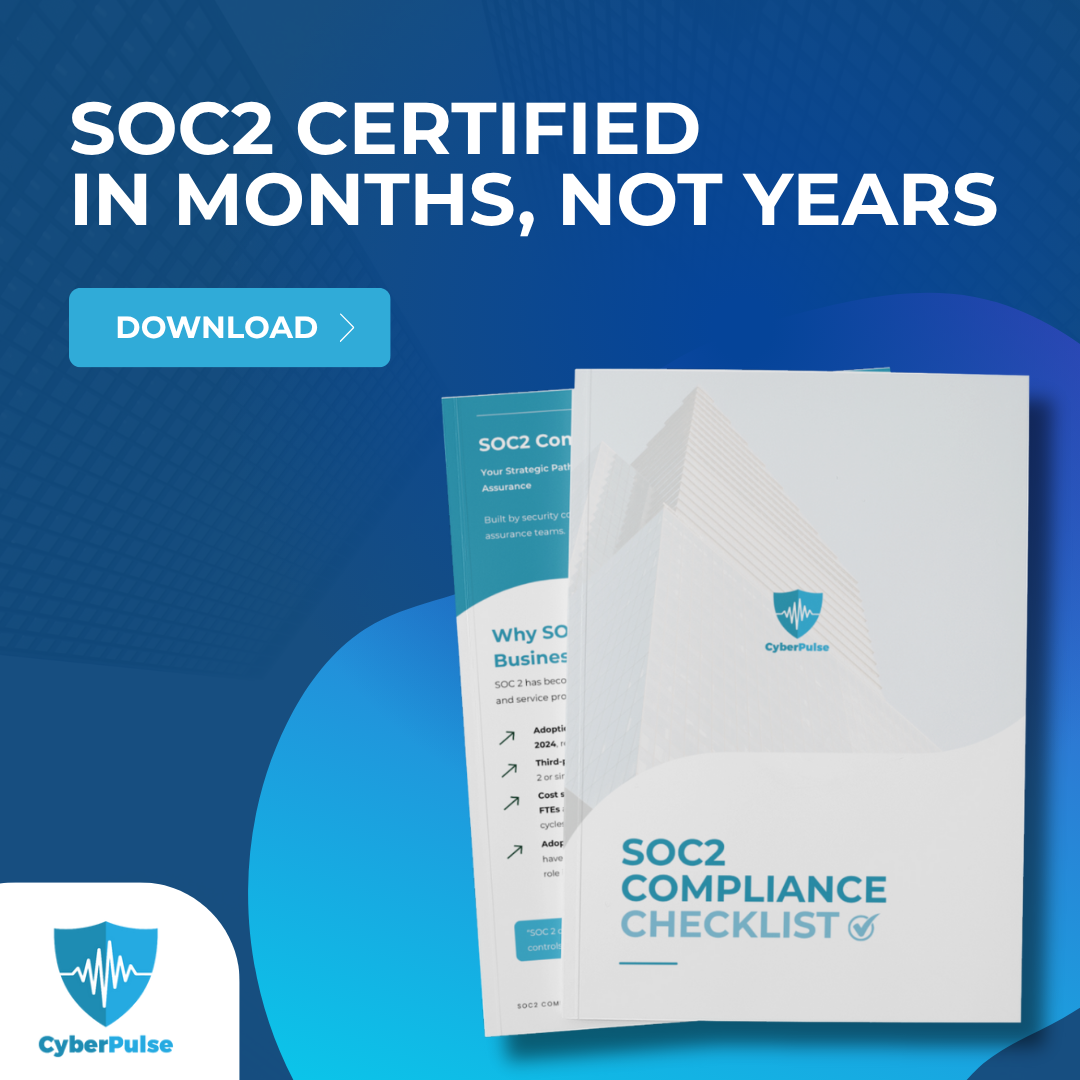
Our SOC 2 Audit Services
SOC 2 Readiness Assessment & Gap Analysis (SOC 2 Type 1 & Type 2)
SOC 2 Control Scoping & Risk Mapping (aligned to AICPA TSC)
SOC 2 Policy & Procedure Development (Security, Availability, Confidentiality, etc.)
Technical Control Implementation: MFA, logging, alerting, encryption, DR/BCP
SOC 2 Evidence Collection & Control Validation
SOC 2 Remediation Support: We help close technical & procedural compliance gaps
SOC 2 Audit Liaison & Pre-Audit Simulation
Managed SOC 2 Compliance: Quarterly updates, control drift monitoring, evidence readiness
Get your SOC2 Attestation
Book a SOC 2 Certification Readiness Consultation.
Need more Information?
Book time with one of our consultants
Why CyberPulse?
Expertise
Award Winning Consultants with deep ISO 27001, SOC 2, and PCI-DSS expertise
Fixed-Price
Fixed-price delivery model with predictable costs and timelines
Support
End-to-end support — from gap analysis to certification and beyond
Standards and Frameworks We Support



Related Services
Cloud Security Architecture & DevSecOps Advisory
FAQ – SOC2 Compliance Services
What is SOC 2 compliance?
SOC 2 (Service Organization Control 2) is an internationally recognised compliance framework developed by the American Institute of CPAs (AICPA). It evaluates how organisations manage customer data across five trust principles: security, availability, processing integrity, confidentiality, and privacy. Achieving SOC 2 compliance demonstrates that your organisation has implemented robust controls to safeguard data, reduce risk, and meet regulatory and customer requirements.
What is the difference between SOC 2 audit services and SOC2 certification in Australia?
SOC 2 audit services refer to preparation and execution of an audit engagement. SOC2 certification (a common term) refers to the outcome of that audit; the independent attestation report. Both terms are widely used by customers in Australia and globally, and this page focuses on delivering SOC 2 audit services Australia aligned to AICPA Trust Services Criteria.
Do SOC 2 audit services cover both Type I and Type II?
Yes. Effective SOC 2 audit services in Australia support both Type I (point-in-time control design effectiveness) and Type II (operational effectiveness over a defined period).
Why is SOC 2 important for my organisation?
SOC 2 is increasingly a prerequisite for doing business in regulated sectors such as financial services, healthcare, and SaaS. Customers, partners, and regulators expect proof that you can protect sensitive data. Beyond compliance, SOC 2 provides a competitive edge by building trust with stakeholders, streamlining vendor due diligence, and reducing the cost of repeated security assessments.
What is the difference between SOC 2 Type I and Type II?
-
SOC 2 Type I: Assesses the design of your security controls at a specific point in time.
-
SOC 2 Type II: Evaluates the operational effectiveness of those controls over a period (usually 6–12 months).
Most organisations pursue SOC 2 Type II certification, as it provides stronger assurance to clients and partners.
How long does it take to achieve SOC 2 certification?
The timeline depends on your organisation’s security maturity. Type I assessments can often be achieved in a few months, while Type II requires an audit window of several months to a year. CyberPulse accelerates the process by conducting gap assessments, remediation planning, and ongoing compliance management, ensuring you are audit-ready faster.
What are the benefits of working with CyberPulse on SOC 2 compliance?
CyberPulse provides end-to-end SOC 2 support, from initial gap analysis to remediation, audit readiness, and ongoing compliance. Our GRC & Advisory team delivers:
-
Comprehensive assessments and roadmaps to identify control gaps.
-
Remediation support and documentation development to meet SOC 2 criteria.
-
Ongoing managed compliance services that keep you audit-ready year-round.
-
Fixed-price delivery and predictable costs for clarity and budget control.
By aligning SOC 2 efforts with broader governance, risk, and compliance (GRC) strategies, CyberPulse ensures security compliance is not just achieved, but sustained.
How does SOC 2 align with other frameworks like ISO 27001, PCI-DSS, or HIPAA?
SOC 2 overlaps with many other standards. Controls implemented for SOC 2 can often be mapped to ISO 27001, PCI-DSS, HIPAA, CPS234, and NIST CSF. CyberPulse streamlines compliance by harmonising requirements across multiple frameworks, reducing duplication and audit fatigue.
Can CyberPulse help with SOC 2 readiness and audits?
Yes. Our experts provide SOC 2 readiness assessments, remediation consulting, and direct support for external audits. We also offer Virtual CISO (vCISO) services to guide your organisation through long-term compliance, risk management, and strategic alignment.
Does CyberPulse provide continuous SOC 2 compliance monitoring?
Yes. CyberPulse offers continuous compliance services that automate evidence collection, maintain control monitoring, and ensure year-round audit readiness. This reduces the operational burden on your teams and ensures that compliance remains a business-as-usual process.
How do I get started with SOC 2 compliance at CyberPulse?
Contact CyberPulse to schedule an initial SOC 2 readiness consultation. We will review your current security posture, identify compliance gaps, and develop a tailored roadmap to certification.

SOC 2 Attestation vs Certification: What Australian Organisations Need to Know
SOC 2 attestation vs certification sits among the most commonly misunderstood distinctions in the...

SOC 2 (SOC2) Audit Requirements in Australia: What Organisations Need to Know
Understanding SOC 2 audit requirements helps Australian organisations plan effectively, allocate...

SOC 2 Audit Exceptions and common findings: What Australian organisation need to know
SOC 2 audit exceptions are one of the most common reasons Australian organisations experience...